India has over 1.5 million schools, 1,000+ universities, and 40,000+ colleges serving more than 300 million students. Yet, a staggering 70% of educational institutions still rely on manual processes, spreadsheets, and fragmented software to manage their daily operations.
What is School ERP Software?
School ERP (Enterprise Resource Planning) Software is a comprehensive digital platform that integrates and automates all administrative, academic, and financial operations of an educational institution into a single, unified system.
Think of it as the digital nervous system of your institution.
Unlike ordinary school management software (which typically handles only one function like fee collection or attendance), a complete School ERP connects every department-admissions, academics, finance, human resources, transportation, hostel, library, and communication-into one seamless ecosystem.
Complete Modules of School ERP
A comprehensive School ERP includes 25+ integrated modules:
Admission Management
Online forms, document management, entrance tests, merit lists, enrollment
Student Information
Profiles, family details, health records, academic history, transfer management
Attendance Management
Daily marking, biometric integration, leave management, parent notifications
Fee Management
Online payments, automated reminders, receipt generation, GST compliance
Examination Management
Scheduling, hall tickets, marks entry, report cards, performance analysis
Timetable Management
Conflict-free generation, teacher workload, substitute management
Learning Management
Course management, content delivery, online assessments, progress tracking
Transport Management
Route management, GPS tracking, driver management, parent notifications
Hostel Management
Room allocation, fee management, attendance, maintenance tracking
Library Management
Cataloging, borrowing/return, fine management, digital library
HR & Payroll
Staff profiles, attendance, leave, payroll, performance tracking
Inventory Management
Stock tracking, purchase orders, supplier management, stock alerts
ERP vs. Ordinary Software: The Critical Difference
| Aspect | Ordinary School Software | Complete School ERP |
|---|---|---|
| Scope | Single function (e.g., only fees) | Entire institution operations |
| Integration | Standalone, siloed | Fully integrated modules |
| Data Visibility | Limited to one department | 360-degree institutional view |
| Reporting | Basic, manual reports | Real-time, automated dashboards |
| Scalability | Limited growth capacity | Scales with your institution |
| Security | Basic security | Enterprise-grade security |
| Mobile Access | Often absent | Mobile-first design |
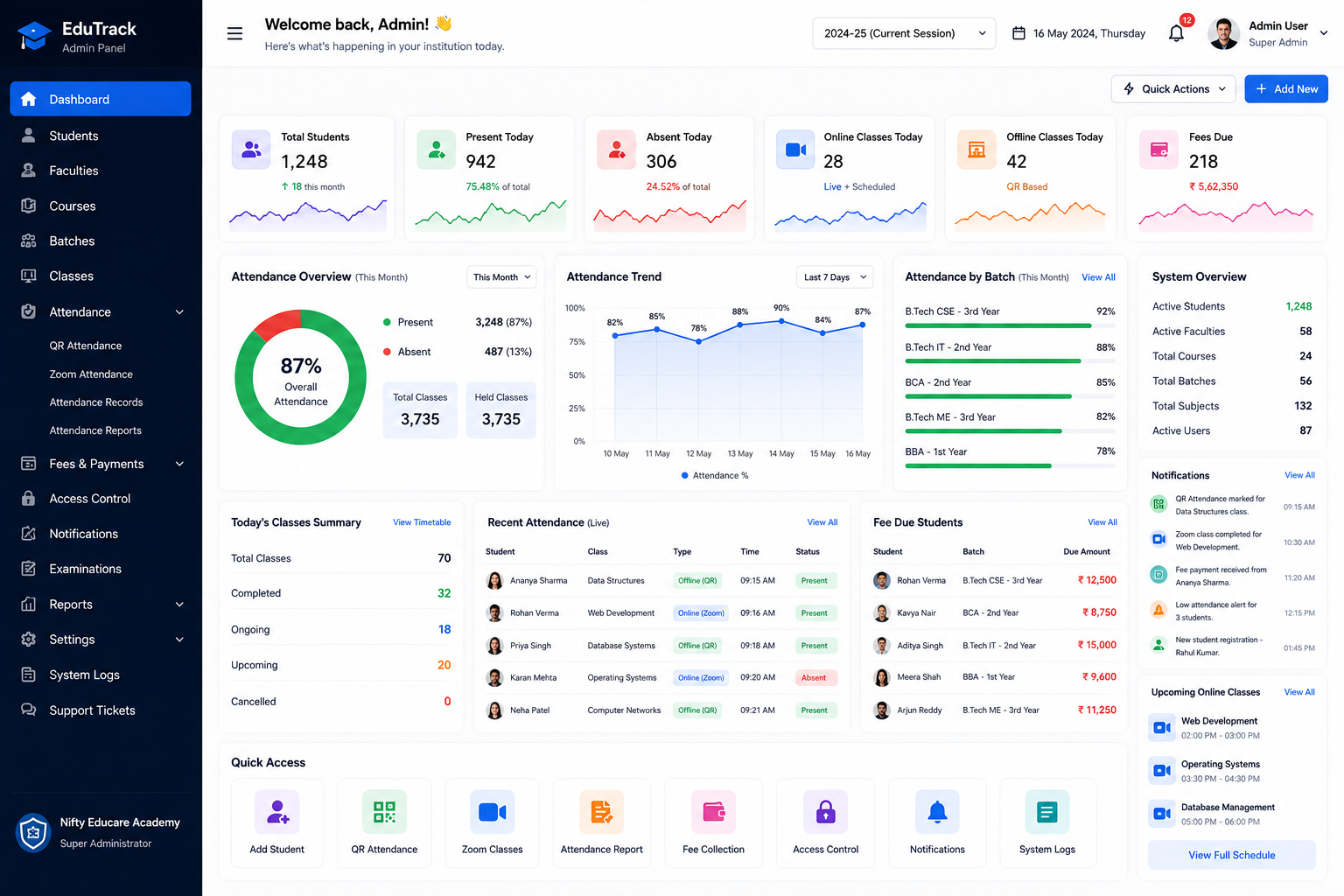
Admin Dashboard
Student Panel

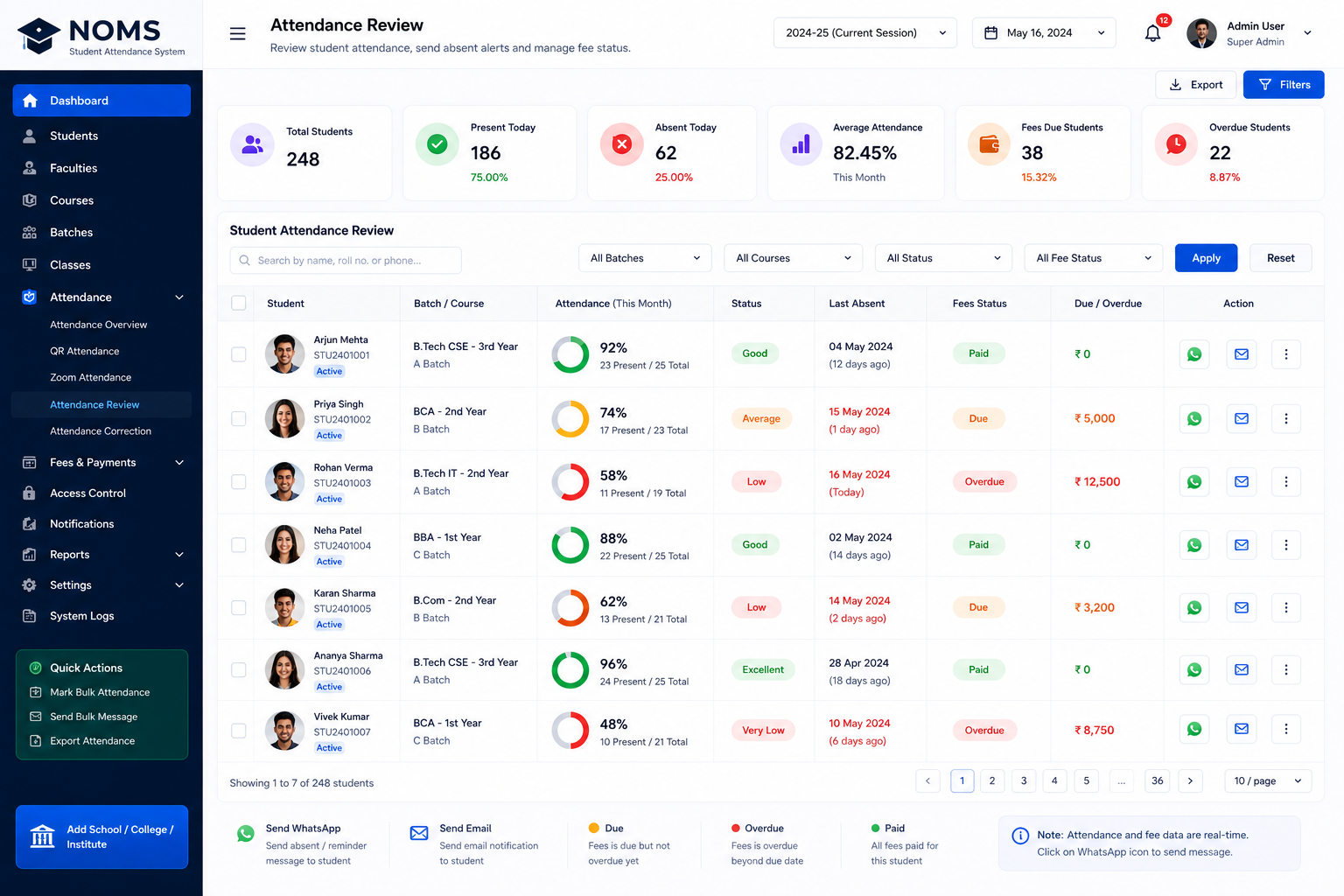
Attendance Overview Panel
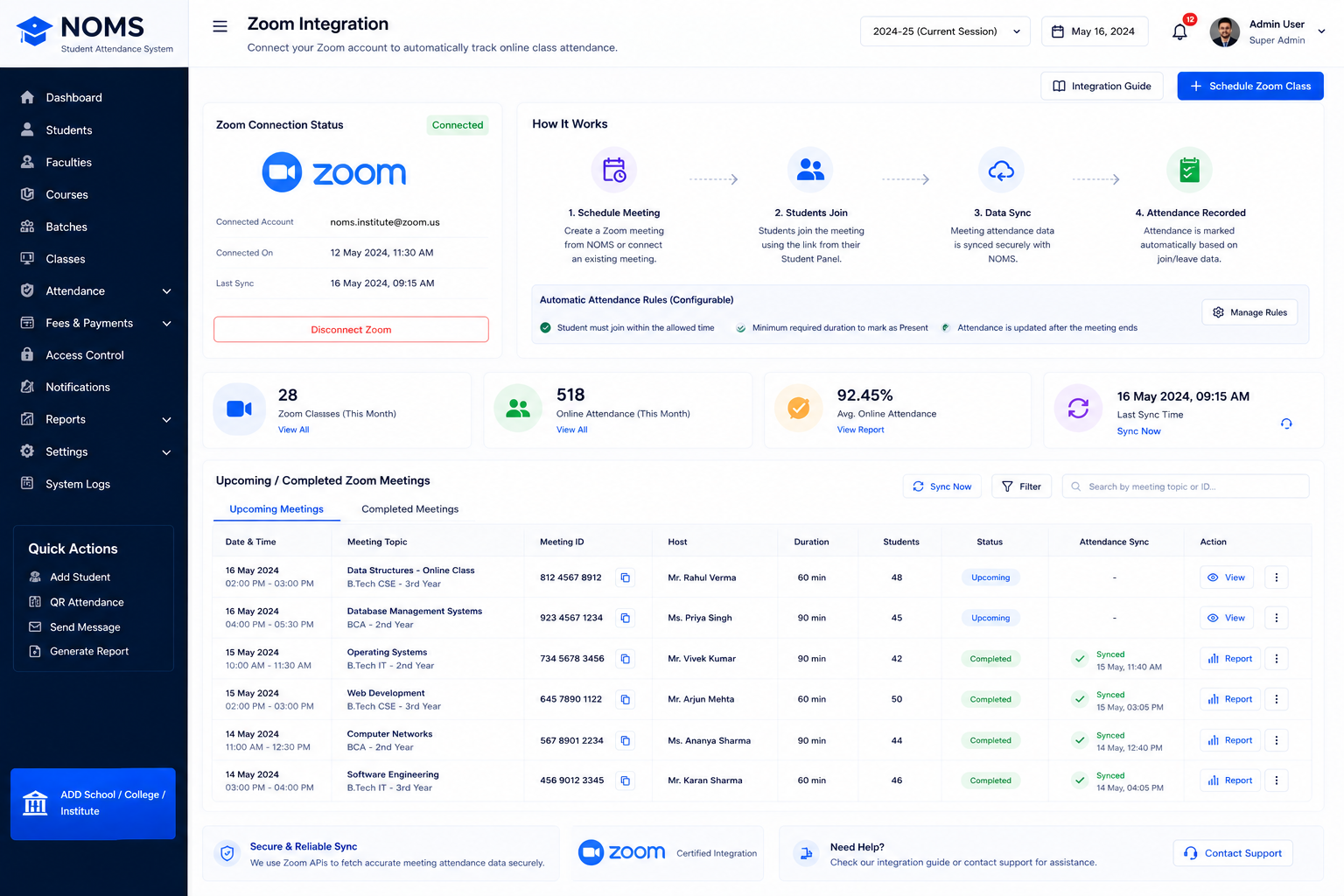
Zoom + Software Integrator
Top Benefits of School ERP Software
1. Save Time
Teachers and administrators spend 30-40% of their time on administrative tasks. School ERP software automates these tasks, freeing up valuable time for teaching and student engagement.
Example: With automated attendance, teachers save 15-20 minutes daily-that's over 60 hours per year.
2. Reduce Paperwork
Indian schools consume millions of sheets of paper annually for registers, forms, report cards, and circulars. School ERP software digitizes everything:
- Digital attendance registers
- Online admission forms
- e-Report cards
- Digital circulars and notices
- Electronic fee receipts
Environmental Impact: A typical school can save 10,000+ sheets of paper annually.
3. Improve Communication
A School ERP with Parent Portal provides seamless communication:
- Real-time notifications for attendance, homework, and events
- WhatsApp and SMS integration for instant alerts
- Centralized announcements for circulars and notices
- Teacher-parent messaging for individual queries
4. Increase Productivity
Automation increases productivity across the institution:
- Teachers spend less time on admin and more time teaching.
- Administrators manage operations efficiently.
- Finance team processes fees faster.
- Principal gets real-time institutional insights.
5. Real-Time Reports & Analytics
A School ERP System provides:
- Student Performance Reports (class-wise, subject-wise)
- Attendance Analytics (trends, patterns)
- Fee Collection Reports (dues, collections)
- Teacher Performance Metrics
- Transportation Reports (route efficiency)
- Hostel Occupancy Reports
6. Cloud Access
A Cloud School ERP offers:
- Anytime, Anywhere Access: Manage your school from any device with internet connection.
- No Infrastructure Costs: No need for expensive servers and IT maintenance.
- Automatic Updates: Always have the latest features and security patches.
- Data Backup: Automatic, secure cloud backups.
7. Mobile App
A School ERP with Mobile App provides:
- Attendance Tracking (real-time)
- Fee Payment (online)
- Exam Results (instant)
- Homework & Assignments
- Communication (messages and announcements)
- Transport Tracking
8. Better Parent Satisfaction
When parents are informed, engaged, and satisfied, they:
- Renew admissions year after year
- Refer other parents to your school
- Pay fees on time without reminders
- Trust the administration and teachers
Advanced Features
1. Artificial Intelligence (AI)
- Predictive Analytics: Identify at-risk students before they fail.
- Student Performance Forecasting: Predict exam scores and suggest interventions.
- Intelligent Recommendations: Suggest courses, books, and activities.
- Automated Personalization: Tailor learning paths to individual students.
2. WhatsApp Notifications
- Instant updates for fees, attendance, homework, and results.
- Two-way communication for parent-teacher interactions.
- Automated bulk broadcasting for circulars and announcements.
3. Online Payment
- Multiple payment gateways (UPI, credit/debit cards, net banking).
- Recurring payments for fees and subscriptions.
- Instant payment confirmation and receipt generation.
4. Biometric Integration
- Fingerprint attendance for students and staff.
- Access control for campus security.
- Integration with attendance and payroll systems.
5. GPS Tracking
- Real-time bus tracking for parents.
- Location-based attendance verification.
- Fleet management for school transportation.
6. Data Security
- ISO 27001 Certification: Enterprise-grade security standards.
- End-to-End Encryption: Data encrypted in transit and at rest.
- Regular Security Audits: Vulnerability assessments and penetration testing.
- Multi-Factor Authentication: Enhanced login security.
Why Modern Schools Need ERP
The modern educational landscape has evolved dramatically. Here's why a School ERP System is no longer optional:
- Parent Expectations: Today's parents demand instant access to their child's attendance, grades, homework, and fee status. They want everything on their phone-not a monthly report card.
- NEP 2020 Compliance: The National Education Policy 2020 emphasizes technology integration, continuous assessment, and holistic student development. A School ERP provides the digital infrastructure to comply with NEP requirements.
- Administrative Efficiency: With rising operational costs and increasing competition, schools need to reduce administrative overhead and focus resources on education quality.
- Data-Driven Decisions: Principals and administrators need real-time insights into attendance patterns, fee collections, academic performance, and staff productivity to make informed decisions.
- Competitive Advantage: Schools that embrace technology attract more admissions, retain students longer, and build stronger parent relationships.
Why Schools in India Need ERP in 2026
The education landscape in India is undergoing its most significant transformation in decades. Several powerful forces are converging to make School ERP Software an absolute necessity in 2026.
1. Digital Transformation is No Longer Optional
The pandemic accelerated digital adoption in education by nearly a decade. Parents, teachers, and students now expect digital-first experiences. Schools that resist technology are perceived as outdated-and parents are increasingly choosing institutions with modern digital infrastructure.
2. NEP 2020 Implementation
The National Education Policy 2020 is being rolled out across India. Key requirements include:
- Continuous and Comprehensive Evaluation (CCE): Tracking student progress throughout the year, not just through final exams.
- Holistic Development: Monitoring academic, co-curricular, and extracurricular activities.
- Technology Integration: Using AI, automation, and digital tools to enhance learning and administration.
- Flexible Learning Paths: Supporting multiple entry/exit points and diverse learning modes.
A School ERP System provides the technological foundation to implement NEP 2020 effectively.
3. Online & Hybrid Learning Models
The lines between physical and digital classrooms have permanently blurred. Schools need systems that support:
- Learning Management Systems (LMS): For online content delivery and assignments.
- Virtual Classrooms: Integration with platforms like Zoom, Google Meet, and Microsoft Teams.
- Digital Content Management: Storing and sharing educational resources.
- Assessment Tools: Online examinations, quizzes, and assignments.
4. Rising Parent Expectations
Modern parents are tech-savvy and demand:
- Real-time Attendance Updates: Know when their child arrives and leaves school.
- Instant Fee Payment: Pay fees online with a few clicks.
- Academic Progress Visibility: Access grades, assignments, and teacher feedback anytime.
- Communication: Receive circulars, notices, and alerts via WhatsApp and SMS.
5. Administrative Complexity
Managing a school in 2026 involves coordinating:
- 500-5,000+ students with unique academic journeys
- 50-300+ teachers with different workloads and responsibilities
- Multiple fee structures and payment plans
- Complex transportation routes with 100+ buses
- Hostel accommodations for hundreds of students
- Library with thousands of books and digital resources
- Examinations across multiple classes and subjects
- Staff payroll with statutory compliance
Without an integrated Education ERP Software, this complexity leads to chaos, errors, and wasted resources.
6. Regulatory Compliance
Indian schools must comply with various regulations:
- CBSE/ICSE/State Board Requirements: Exam schedules, curriculum, and reporting.
- RTE Act 2009: Admissions, attendance, and infrastructure norms.
- GST and Tax Regulations: Fee structuring and financial compliance.
- Data Protection: Student data security and privacy.
A Cloud School ERP helps institutions maintain compliance effortlessly with automated reporting and audit trails.
Major Challenges Without School ERP
1. Manual Attendance Management
The Problem: Teachers mark attendance in paper registers. Attendance is consolidated manually at month-end. Errors are common, and parents have no real-time visibility.
The Cost: Wasted teacher time, attendance fraud, inaccurate student records, and delayed parent communication.
2. Fee Collection Chaos
The Problem: Parents pay fees through cash, cheque, or bank transfers. The accounts team manually tracks payments, sends reminders, and generates receipts. Many parents miss deadlines.
The Cost: Revenue leakage, delayed cash flow, staff time spent on follow-ups, and frustrated parents.
3. Admission Management Overload
The Problem: Admissions involve forms, documents, entrance tests, merit lists, and communication-all managed manually. Hundreds of applications create chaos.
The Cost: Lost applications, delayed admissions, poor candidate experience, and missed enrollment targets.
4. Communication Gaps
The Problem: Schools use WhatsApp groups, emails, phone calls, and physical notices-but messages get missed, and communication is fragmented.
The Cost: Misinformation, missed deadlines, frustrated parents, and damaged reputation.
5. Exam Management Nightmare
The Problem: Exam scheduling, hall ticket creation, answer sheet management, marks entry, result calculation, and report card generation are all manual processes.
The Cost: Exam delays, marking errors, delayed results, and stressed teachers.
6. Student Records Silos
The Problem: Student data is scattered across registers, spreadsheets, and different departments.
The Cost: Inconsistent records, data duplication, time wasted searching for information, and poor decision-making.
7. Payroll & HR Challenges
The Problem: Staff attendance, leave management, payroll processing, and compliance are handled manually.
The Cost: Payroll errors, compliance issues, employee dissatisfaction, and wasted administrative time.
8. Transportation Logistics
The Problem: Managing bus routes, driver details, student pick-up/drop-off, and parent communication is complex and manual.
The Cost: Safety risks, parent complaints, operational inefficiencies.
9. Hostel Management Chaos
The Problem: Hostel admission, room allocation, fee collection, attendance, and maintenance are handled manually.
The Cost: Lost revenue, unhappy students, and parent complaints.
10. Library Management Inefficiency
The Problem: Book cataloging, borrowing/return tracking, fine collection, and inventory management are manual.
The Cost: Lost books, inefficient operations, and student dissatisfaction.
School ERP vs Traditional Management
| Aspect | Traditional Management | School ERP Software |
|---|---|---|
| Attendance | Paper registers, manual consolidation | Automated, real-time, parent notifications |
| Fee Collection | Cash/cheque, manual tracking | Online payments, automated reminders |
| Admissions | Paper forms, manual processing | Online forms, automated workflows |
| Examinations | Manual scheduling, delayed results | Automated scheduling, instant results |
| Reports | Manual compilation, weeks to generate | Real-time, automated, one-click reports |
| Communication | Fragmented (WhatsApp, phone) | Centralized, multi-channel, automated |
| Data Storage | Physical files, scattered systems | Centralized, secure, cloud storage |
| Parent Engagement | Periodic meetings, limited updates | Continuous, real-time, mobile-first |
| Security | Basic, unorganized | ISO certified, encryption, role-based |
| Scalability | Difficult to scale | Seamlessly scales with growth |
| Decision Making | Intuition-based | Data-driven, analytics-powered |
How School ERP Improves Student Performance
1. Early Identification of Struggling Students
The ERP tracks attendance patterns, homework submission rates, quiz scores, and test performance. AI algorithms identify students who are falling behind before they fail.
Example: If a student's attendance drops below 80% and homework submissions are consistently late, the system alerts the teacher and counselor. They can intervene early with personalized support.
2. Personalized Learning Paths
The School ERP analyzes each student's performance data to recommend personalized learning resources and activities.
3. Continuous Assessment
Instead of relying on final exams, the ERP supports continuous assessment through homework, quizzes, assignments, projects, and class participation.
4. Improved Teacher Productivity
By automating administrative tasks, teachers have more time for lesson planning, student interaction, and personalized instruction.
5. Parental Involvement
The Parent Portal gives parents real-time visibility into their child's performance, attendance, and progress.
How School ERP Helps Parents
1. Real-Time Attendance Tracking
Parents receive instant notification when their child arrives or leaves school. Daily attendance summary with date and time.
2. Online Fee Payment
Complete fee structure, due dates, payment history, and instant receipts. Multiple payment options (UPI, cards, net banking).
3. Exam Results & Progress Reports
Detailed exam results, grade reports, progress card, performance trends, and teacher feedback.
4. Homework & Assignments
Daily homework assignments, submission deadlines, assignment status, and teacher feedback.
5. School Communication
Circulars, announcements, event invitations, holiday schedules, and teacher messages.
6. Transport Tracking
Live bus location, estimated arrival time, route details, and driver contact information.
How Teachers Benefit from School ERP
1. Attendance Management
Teachers spend just 2 minutes marking attendance electronically-compared to 15 minutes with paper registers.
2. Marks Entry & Result Calculation
Entering marks and calculating results takes minutes, not hours.
3. Lesson Planning
Teachers can plan lessons online, aligning them with curriculum and syllabus.
4. Assignment Management
Create and assign homework with deadlines. Track submissions and grade assignments online.
5. Student Communication
Send messages, feedback, and reminders to students and parents directly from the platform.
6. Timetable Management
Teachers can view their daily, weekly, and monthly schedule instantly.
Pricing Guide for School ERP Software
Pricing Models
| Model | Description | Best For |
|---|---|---|
| Subscription (SaaS) | Monthly/yearly subscription fee. No upfront infrastructure cost. | Small to medium schools |
| Per-Student Pricing | Fee based on student count. Scales with enrollment. | Schools with growing enrollment |
| Per-Module Pricing | Pay only for modules you need. | Schools wanting to start small |
| One-Time License | Upfront payment for perpetual license. Separate maintenance fees. | Large institutions with dedicated IT |
| Enterprise Custom Pricing | Tailored pricing for large groups or multi-campus institutions. | Chains, universities, large trusts |
Typical Pricing Range
| Institution Size | Approximate Annual Cost |
|---|---|
| Small School (100-500 students) | ₹50,000 - ₹1,50,000 |
| Medium School (500-2,000 students) | ₹1,50,000 - ₹4,00,000 |
| Large School (2,000-5,000 students) | ₹4,00,000 - ₹10,00,000 |
| College / University | ₹10,00,000+ |
How to Choose the Best School ERP Software
Step 1: Define Your Requirements
- Current Pain Points: What are your biggest challenges?
- Must-Have Features: List non-negotiable modules.
- Nice-to-Have Features: Advanced features like AI or biometric integration.
- Institution Size: Number of students, teachers, staff, and campuses.
- Budget: Define your budget range.
Step 2: Create a Vendor Shortlist
- Industry Reputation: Years in business, client testimonials.
- School ERP Experience: Specific experience with educational institutions.
- Product Features: Alignment with your requirements.
- Technology Stack: Modern, scalable, secure.
- Pricing: Transparent, within budget.
Step 3: Request Demos
- Live Demo: See the software in action with your use cases.
- Ask Questions: Challenge the vendor with your specific scenarios.
- Involve Team: Include administrators, teachers, and IT staff.
Step 4: Check References
- Similar Schools: Institutions of similar size and type.
- Implementation Experience: How was the process?
- Ongoing Support: How responsive is the support team?
- User Satisfaction: Are teachers, parents, and admin happy?
Future of School ERP
1. Artificial Intelligence
- Predictive Analytics: Identify at-risk students before they fail.
- Personalized Learning: AI-driven recommendations for each student.
- Automated Grading: AI can grade essays, assignments, and tests.
- Intelligent Tutoring: AI-powered virtual assistants for students.
2. Machine Learning
- Student Performance Prediction: Forecast academic outcomes.
- Attendance Pattern Analysis: Identify anomalies and trends.
- Fee Payment Prediction: Forecast revenue and identify defaults.
3. Predictive Analytics
- Dropout Prediction: Identify students at risk of dropping out.
- Academic Performance: Forecast individual and class performance.
- Resource Optimization: Predict infrastructure and resource needs.
4. Cloud Computing
- Edge Computing: Processing data closer to users.
- Hybrid Cloud: Flexible deployment options.
- Serverless Computing: Cost-effective, scalable infrastructure.
Frequently Asked Questions (25+)
Conclusion
The future of education is digital, and School ERP Software is the foundation of that future. From automating manual processes to enabling data-driven decisions, from improving parent satisfaction to enhancing student outcomes, the benefits of School ERP are undeniable.
Whether you're a school owner, principal, administrator, or educational entrepreneur, investing in the best School ERP software in India will transform your institution into a modern, efficient, and competitive educational organization.
In 2026, the question is no longer "Should we adopt School ERP?" but "Which School ERP is right for us?"
Take School Management Software In Action
Schedule a personalized demo and discover how our School Management Software can transform your system & get 14 Days free trial.