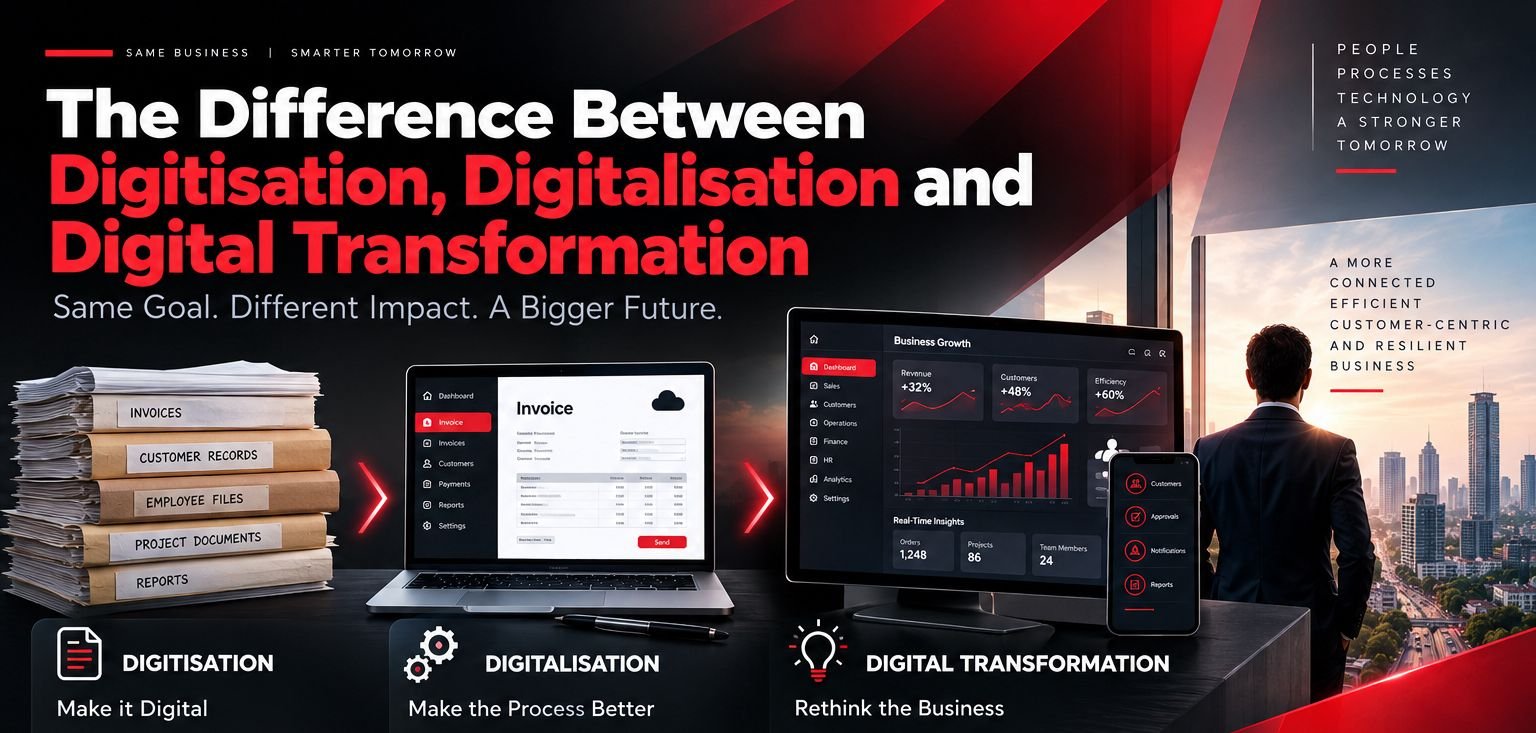
Many businesses say they are going through digital transformation.
But sometimes, all they've done is replace a filing cabinet with a computer.
That isn't necessarily a bad thing. Digitising information can be useful. Moving from paper to digital can create efficiency, accessibility and better record keeping.
But converting paper into PDFs does not automatically mean a business has transformed.
Digitisation → Make it digital.
Digitalisation → Make the process better.
Digital Transformation → Rethink how the business works.
Understanding the distinction can change how leaders think about technology, processes, people, customers, data, automation, business models, strategy and growth.
The question worth asking is this: Are we simply making things digital, making processes better, or actually rethinking how our business works?
What Is Digitisation?
Digitisation is the process of converting information from a physical or analogue format into a digital format.
The information changes format. The underlying process may remain exactly the same.
Examples of digitisation include:
- Paper invoice → digital invoice
- Paper customer record → digital customer record
- Printed document → PDF
- Physical photograph → digital image
- Paper attendance register → digital attendance record
- Physical quotation → digital quotation
- Paper purchase order → digital purchase order
- Manual archive → digital archive
- Physical forms → digital forms
Example:
Old: Employee fills paper form → Manager signs → Office stores document
Digitised: Employee fills digital form → Manager signs digitally → Office stores PDF
The format changed. The fundamental workflow may not have changed.
Digitisation changes the format. It doesn't necessarily change the way the business works.
Why Digitisation Still Matters
Digitisation is not unimportant. It provides a foundation for future digital processes and creates immediate practical benefits.
- Easier storage
- Easier retrieval
- Better accessibility
- Reduced physical paperwork
- Easier sharing
- Better searchability
- Reduced risk of physical document loss
- Foundation for future digital processes
You cannot build a data-driven process from information that is trapped in filing cabinets.
What Is Digitalisation?
Digitalisation uses digital technologies to improve existing business processes.
The underlying business activity still exists. But the process becomes faster, more connected, more measurable, easier to monitor and less dependent on manual intervention.
Example: Invoicing
Traditional process: Prepare invoice → Print → Send → Wait → Call customer → Check payment → Update record
Digitalised process: Customer data stored digitally → Invoice generated electronically → Invoice sent automatically → Payment status tracked digitally → Reminder triggered → Dashboard updated
Digitisation makes something digital. Digitalisation uses digital capabilities to make something work better.
Examples of Digitalisation
- Automated invoicing
- Online appointment booking
- Digital employee attendance
- CRM-based sales follow-ups
- Automated payment reminders
- Inventory alerts
- Digital approval workflows
- Automated email notifications
- Online customer service
- Digital project tracking
- Automated reporting
- Online procurement workflows
What Is Digital Transformation?
Digital transformation is broader than converting documents or improving individual processes. It involves fundamentally rethinking how the business operates, creates value and serves customers using digital capabilities.
It can involve rethinking:
- Business operations
- Customer experience
- Employee experience
- Decision-making
- Products and services
- Business models
- Revenue models
- Organisational structures
- Technology architecture
The technology matters. But the bigger change is how the business operates because of it.
Retail Example: Three Stages
Digitisation: Paper customer records → digital customer records.
Digitalisation: Online ordering and automated order processing.
Digital Transformation: Completely rethink customer experience - discovery, recommendation, purchase, payment, fulfilment, delivery, support, personalisation, retention.
Technology enables the change but does not define the transformation.
Read article on linkedin: Read Article
One Business, Three Stages
| Aspect | Digitisation | Digitalisation | Digital Transformation |
|---|---|---|---|
| Definition | Convert analogue to digital | Use digital tech to improve processes | Rethink how business operates |
| Primary Focus | Information format | Process improvement | Business model & strategy |
| Scope | Individual records | Specific processes | Entire organisation |
| Technology Role | Storage & access | Automation & workflow | Strategic enabler |
| Process Change | Minimal | Improved | Redesigned |
| People Impact | New tools | New ways of working | New roles & culture |
| Customer Impact | Digital records | Faster service | Redesigned experience |
| Business Model Impact | None | Limited | Fundamental |
| Example | PDF invoice | Automated invoicing | Quote-to-cash redesign |
A Simple Real-World Example: Invoice
Stage 1 - Digitisation: Paper invoice becomes PDF.
Stage 2 - Digitalisation: Invoices generated automatically and payment status tracked.
Stage 3 - Digital Transformation: The company redesigns its entire quote-to-cash process.
Customer enquiry → Quote → Approval → Contract → Invoice → Payment → Automated reminders → Revenue analytics → Customer insights.
The business starts managing cash flow proactively instead of simply recording transactions.
A Simple Real-World Example: Customer Service
Digitisation: Customer records stored digitally.
Digitalisation: CRM automatically records interactions and assigns follow-ups.
Digital Transformation: Customer service becomes proactive and data-driven.
The business can predict customer needs, personalise communication, identify churn risks, automate routine support, create omnichannel experiences and use customer insights to improve products.
A Simple Real-World Example: Manufacturing
Digitisation: Paper production records become digital.
Digitalisation: Production data is entered into software and reports are automated.
Digital Transformation: Production becomes data-driven and connected across planning, procurement, inventory, production, quality, dispatch, finance and analytics.
A Simple Real-World Example: Construction
Digitisation: Paper project records become digital documents.
Digitalisation: Project software tracks tasks, materials, labour, purchases, expenses and billing.
Digital Transformation: Management gets a connected view of project progress, project cost, material consumption, labour, procurement, billing and profitability.
The transformation comes from changing how decisions are made, not simply from buying software.
A Simple Real-World Example: Education
Digitisation: Paper student records become digital records.
Digitalisation: Admissions, attendance and fees become digitally managed.
Digital Transformation: The institution redesigns the student and administrative experience through digital admissions, student portals, automated communication, data-driven academic insights, digital payments, online learning, personalised student engagement and integrated management reporting.
Why Businesses Confuse the Three Terms
- Marketing language blurs the lines
- Technology vendors use the terms loosely
- "Digital transformation" sounds more strategic
- Companies equate technology adoption with transformation
- New software feels like major change
- Leaders may not distinguish process improvement from strategic transformation
- Digital transformation has no single universal definition
Technology Does Not Equal Transformation
Consider these common situations:
- A company buys a CRM but salespeople still maintain Excel sheets.
- A company buys ERP but departments continue working separately.
- A company moves documents to cloud storage but approvals remain manual.
- A company launches an app but customer experience remains fragmented.
- A company creates dashboards but management decisions remain based on intuition.
Buying technology is not transformation. Using technology to rethink how the business operates can be transformation.
More Technology Does Not Automatically Mean More Transformation
A company can have cloud software, mobile apps, dashboards, AI tools, automation, digital documents, SaaS platforms and analytics - and still operate with old approval systems, manual workflows, siloed departments, duplicate data, slow decisions, poor customer experience and outdated organisational thinking.
A digitally equipped business is not necessarily a digitally transformed business.
The People Dimension
Transformation is not purely technological. It involves employee adoption, training, culture, leadership, change management, collaboration, new skills, resistance to change and accountability.
Example: A company implements a new ERP. Technology is ready. Employees continue using spreadsheets. The transformation has not happened.
The Process Dimension
Digitising a bad process does not automatically create a good process.
Old process: Five approvals required for a simple purchase.
Digitised version: Five digital approvals. Still inefficient.
Digitalisation: Automate routine approvals.
Transformation: Redesign procurement authority, approval thresholds, supplier workflows and decision-making.
The Data Dimension
Digitisation: Data becomes digital.
Digitalisation: Data becomes easier to access and process.
Digital Transformation: Data becomes a strategic business asset.
This includes dashboards, analytics, forecasting, customer insights, performance indicators, predictive decision-making and data-driven strategy.
The Customer Experience Dimension
Digitisation: Digital records.
Digitalisation: Faster service.
Transformation: Completely redesigned customer journey.
Discover → Enquire → Compare → Purchase → Payment → Delivery → Support → Feedback → Personalisation → Loyalty
The Employee Experience Dimension
Digitisation: Employees access digital documents.
Digitalisation: Employees use software to complete work faster.
Transformation: Employees work in fundamentally different ways.
Examples include remote collaboration, digital workflows, automated repetitive work, self-service systems, real-time dashboards, AI-assisted tasks and cross-functional collaboration.
Digital Transformation and Business Models
Transformation can go beyond internal processes. It can change the underlying model of delivering value.
- Traditional newspaper → Digital publishing
- Traditional taxi model → App-based mobility
- Traditional retail → Omnichannel commerce
- Traditional banking → Mobile-first banking
- Traditional media → Streaming platforms
Digitisation → Digitalisation → Transformation
These should not be viewed as competing choices. They can form a progression.
Information
Processes
Business Model / Operating Model / Customer Experience
Does Every Business Need Digital Transformation?
No. Not every company needs a massive transformation programme.
Some businesses may simply need digitisation, process automation, better software, better reporting, cloud migration or improved customer communication.
Transformation should follow business needs.
The right question is not "How digital can we become?" but "What business problem are we trying to solve?"
When Should a Business Digitise?
- Important information remains on paper
- Documents are difficult to retrieve
- Physical records create delays
- Information sharing is slow
- Records are difficult to search
- Data needs to become accessible to digital systems
When Should a Business Digitalise?
- Processes are repetitive
- Employees spend too much time on manual work
- Approvals are slow
- Customers wait for updates
- Reporting is manual
- Teams duplicate data
- Follow-ups are missed
- Management lacks real-time visibility
When Should a Business Consider Digital Transformation?
- Existing business model is under pressure
- Customer expectations are changing
- Competitors operate differently
- Departments are disconnected
- Digital channels are becoming strategically important
- Data is not being used effectively
- Manual processes limit growth
- Business needs scalable operations
- Management wants real-time decision-making
- Technology needs to become part of the business strategy
The CEO Question
The most useful question isn't: "How much technology are we using?"
It is: "What has actually changed in the way we operate?"
Ask:
- Are we simply converting information?
- Are we improving processes?
- Are we redesigning workflows?
- Are we changing customer experience?
- Are we improving decision-making?
- Are we changing employee roles?
- Are we creating new value?
- Are we changing the business model?
Questions CEOs Should Ask Before Buying Technology
- What problem are we solving?
- Is the problem technological or operational?
- Are we digitising a bad process?
- Can the process be simplified first?
- Who will use the system?
- What should be automated?
- What data do we need?
- What decisions should become faster?
- How will customers benefit?
- How will employees benefit?
- How will management measure success?
- Can the system scale?
- How will departments connect?
- What happens if employees don't adopt it?
- What should remain human?
- What should be automated?
- What business outcome are we targeting?
- How will we measure ROI?
- What should change operationally?
- Are we buying software or redesigning the business?
Digital Transformation Roadmap
Understand Current State
Identify Business Problems
Map Existing Processes
Remove Unnecessary Steps
Digitise Information
Digitalise Repetitive Processes
Connect Systems & Data
Automate Where Appropriate
Measure Outcomes
Redesign Experiences
Scale Successful Changes
Continuously Improve
Digital Transformation Maturity Model
| Level | Characteristics | Example | Leadership Focus |
|---|---|---|---|
| Level 1: Paper / Manual | Physical records, manual processes | Paper attendance register | Basic record keeping |
| Level 2: Digitised | Information in digital format | PDF attendance records | Digital storage |
| Level 3: Digitalised | Processes use digital tools | Digital attendance system | Process efficiency |
| Level 4: Integrated | Systems connected | Attendance linked to payroll | Integration |
| Level 5: Data-Driven | Data informs decisions | Attendance analytics dashboard | Decision-making |
| Level 6: Transformed | Business model redesigned | Workforce optimisation platform | Strategic reinvention |
Common Digital Transformation Mistakes
| Mistake | Why It Happens | Better Approach |
|---|---|---|
| Buying software before defining the problem | Technology-first thinking | Define business problem first |
| Digitising inefficient processes | Not questioning existing workflows | Simplify processes before digitising |
| Treating transformation as an IT project | Technical focus rather than business focus | Business-led, technology-enabled |
| Ignoring employees | Top-down implementation | Involve employees in design and rollout |
| Ignoring customers | Internal focus | Start with customer experience |
| No executive ownership | Delegated to middle management | CEO-level sponsorship |
| Too many disconnected tools | Departmental purchases | Integrated platform strategy |
| Poor data quality | No data governance | Data quality as priority |
| No integration strategy | Siloed thinking | Plan integrations upfront |
| No measurement | Activity focus | Define success metrics |
| No change management | Underestimating adoption | Structured change programme |
| Trying to transform everything at once | Overwhelm | Phased approach |
| Chasing every new technology | FOMO | Technology follows business needs |
| Ignoring cybersecurity | Security as afterthought | Security by design |
| Ignoring scalability | Short-term thinking | Plan for growth |
Digital Transformation and AI
AI can be part of digital transformation but does not automatically equal transformation.
- Using AI to generate an email → digital tool adoption
- Using AI to automate a repetitive workflow → digitalisation
- Redesigning an entire customer service model around intelligent automation, human support and predictive insights → potentially digital transformation
AI does not automatically transform a business.
Cloud, Automation, ERP and CRM
Technologies such as cloud computing, ERP, CRM, workflow automation, analytics, mobile applications, APIs and AI can enable digitalisation and transformation.
But technology itself is not the transformation.
How ERP Can Support Digital Transformation
ERP can connect finance, HR, inventory, procurement, sales, projects, operations and reporting.
- Digitisation: Digital records
- Digitalisation: Automated workflows
- Transformation: Connected operational decision-making
ERP alone does not transform a company.
How CRM Can Support Digital Transformation
- Digitisation: Digital customer records
- Digitalisation: Automated sales follow-ups
- Transformation: Customer experience becomes data-driven and proactive
Business Size Does Not Determine Transformation
Digital transformation isn't only for large corporations.
- Small business: Digitise customer records and automate invoices
- Medium business: Integrate CRM, finance and operations
- Enterprise: Redesign customer experience, operations and data architecture
Industry Examples
| Industry | Digitisation | Digitalisation | Digital Transformation |
|---|---|---|---|
| Manufacturing | Digital production records | Automated production reports | Connected production, procurement, inventory & finance |
| Construction | Digital project documents | Project tracking software | Connected project cost, materials, labour & billing |
| Education | Digital student records | Digital admissions & attendance | Integrated student experience & analytics |
| Healthcare | Digital patient records | Appointment scheduling systems | Connected patient journey & data-driven care |
| Retail | Digital product catalogues | Online ordering & payment | Omnichannel customer experience |
| Finance | Digital statements | Automated reporting | Data-driven financial services |
| Logistics | Digital shipment records | Tracking systems | Connected supply chain visibility |
| Real Estate | Digital property listings | CRM for leads & sales | Data-driven customer journey |
| Professional Services | Digital client files | Project management software | Integrated client & project experience |
| Travel | Digital bookings | Automated itineraries | Personalised travel experiences |
Digitisation vs Digitalisation vs Digital Transformation
| Aspect | Digitisation | Digitalisation | Digital Transformation |
|---|---|---|---|
| Definition | Convert analogue to digital | Use digital tech to improve processes | Rethink how business operates |
| Primary Focus | Information format | Process improvement | Business model & strategy |
| Scope | Individual records | Specific processes | Entire organisation |
| Technology Role | Storage & access | Automation & workflow | Strategic enabler |
| Process Change | Minimal | Improved | Redesigned |
| People Impact | New tools | New ways of working | New roles & culture |
| Customer Impact | Digital records | Faster service | Redesigned experience |
| Data Role | Digital storage | Accessible & processable | Strategic asset |
| Business Model Impact | None | Limited | Fundamental |
| Typical Investment | Low | Medium | High |
| Typical Outcome | Digital records | Efficient processes | New value creation |
| Example | PDF invoice | Automated invoicing | Quote-to-cash redesign |
Real-World Business Story
This is a fictional example, not a NifTycoon customer case study.
A growing company manages operations using Excel, paper records, email, WhatsApp and separate accounting software.
Stage 1 - Digitisation: The company scans paper records and stores them digitally. Documents are easier to find.
Stage 2 - Digitalisation: The company implements CRM, automated invoicing and digital approval workflows. Processes become faster.
Stage 3 - Transformation: The company redesigns its customer journey, connects departments through integrated systems, uses data for decision-making and changes how it creates value.
How to Measure Digital Transformation
Success should not be measured only by the number of software tools, applications, digital documents or technology spending.
Instead measure:
- Process cycle time
- Customer experience
- Employee productivity
- Decision-making speed
- Error reduction
- Data accessibility
- Revenue opportunities
- Cost efficiency
- Customer retention
- Operational scalability
- Business agility
Digital Transformation Is a Business Journey
Transformation is continuous. Technology changes. Customer expectations change. Markets change. Business models change.
Therefore businesses need continuous improvement.
Digital transformation is not a destination you arrive at after installing software. It is an ongoing ability to rethink how the business creates value.
NifTycoon Context
NifTycoon is a software and business technology company that helps businesses explore software solutions around their operational requirements.
Software platforms can support businesses at different stages:
- Digitisation: Moving business information into structured digital systems
- Digitalisation: Connecting workflows, automation, reporting and operational processes
- Transformation: Using connected technology, data and redesigned processes to improve how the business operates
Relevant areas may include ERP, CRM, business management software, industry-specific software, workflow automation, finance management, HR & payroll, inventory management, project management, construction management, education management, manufacturing management, real estate management, aerospace management and custom software.
Quick Answers: Digitisation, Digitalisation and Digital Transformation
Frequently Asked Questions
Key Takeaways
- Digitisation changes information from physical or analogue to digital.
- Digitalisation uses digital technology to improve existing processes.
- Digital transformation can involve fundamentally rethinking how a business operates.
- More software does not automatically mean more transformation.
- Digitisation can be the foundation for digitalisation.
- Digitalisation can contribute to broader transformation.
- Technology is an enabler of transformation rather than transformation itself.
- People, processes and leadership are critical to digital transformation.
- Businesses should define the problem before selecting technology.
- Digital transformation should be measured by business outcomes rather than technology adoption.
- Not every business needs a massive transformation programme.
- The right question is not "How digital can we become?" but "What business problem are we trying to solve?"
- Transformation is continuous, not a one-time project.
- A digitally equipped business is not necessarily a digitally transformed business.
- Meaningful transformation changes how the business operates, makes decisions and creates value.
Digitisation, Digitalisation and Digital Transformation - At a Glance
Simple way to remember it:
Digitisation = Make it digital.
Digitalisation = Make the process better.
Digital Transformation = Rethink how the business works.
Conclusion
There is no shame in being at the digitisation stage. Digitisation can be exactly what a business needs. Digitalisation may be the appropriate next step. A larger or changing organisation may need a broader transformation strategy.
The right answer depends on the business, customers, processes, goals, industry, scale, readiness and resources.
Technology should follow the business problem - not the other way around.
Ultimately, digital progress isn't measured by how many digital tools a company owns. It is measured by how meaningfully the business has improved.
So perhaps the next time we say, "We're digitally transforming," it is worth asking:
Are we making things digital, making processes better, or actually rethinking how our business works?
Evaluating new software, automation or digital processes?
Start with the business problem - not the technology. NifTycoon helps businesses explore software and technology solutions around their operational requirements, workflows and growth objectives.