Introduction
A business can look extremely active from the outside while internally very little meaningful progress is happening.
Full calendars. Constant meetings. Hundreds of emails. Continuous phone calls. Employees working long hours. Managers solving problems. Teams handling dozens of tasks.
And yet, the business still struggles with delayed projects, missed opportunities, customer dissatisfaction, repeated mistakes, poor profitability and slow decision-making.
This is the contradiction of modern business:
A business can be incredibly busy and simultaneously unproductive.
This article explores the difference between activity, busyness, efficiency, effectiveness and productivity. It examines why businesses become too busy, how to recognise the signs, and what can be done to shift toward meaningful progress.
Not a productivity guide. Not a list of 10 tips. A thoughtful exploration of a common business problem.
What Does It Actually Mean to Be Busy?
Business busyness is the constant activity of doing things. It is the feeling of having too much work, too many demands and not enough time.
In many organizations, busyness looks like:
- Back-to-back meetings with little preparation or follow-through
- Endless email threads and WhatsApp messages that create more questions than answers
- Constant task-switching between unrelated activities
- Firefighting - repeatedly solving the same operational problems
- Manual administrative work that adds no real value
- Employees working long hours just to stay afloat
- Managers spending more time chasing updates than making decisions
Busyness can create the feeling of productivity. When calendars are full and inboxes are overflowing, it is easy to believe that the business is moving forward.
But busyness is not the same as progress. Activity is not the same as achievement.
What Is Productivity in Business?
Productivity in business is not simply:
More hours + more tasks = more productivity
That equation is too simplistic. Productivity is the relationship between resources, effort, output, quality and business value.
Productivity means producing meaningful output with the resources available. It means achieving valuable outcomes, not just completing tasks.
Completing twenty low-value tasks may be less productive than completing one high-impact task. Processing a hundred routine requests may be less valuable than solving one recurring customer problem.
This is why productivity can be difficult to measure. It is not just about quantity. It is about contribution to business goals.
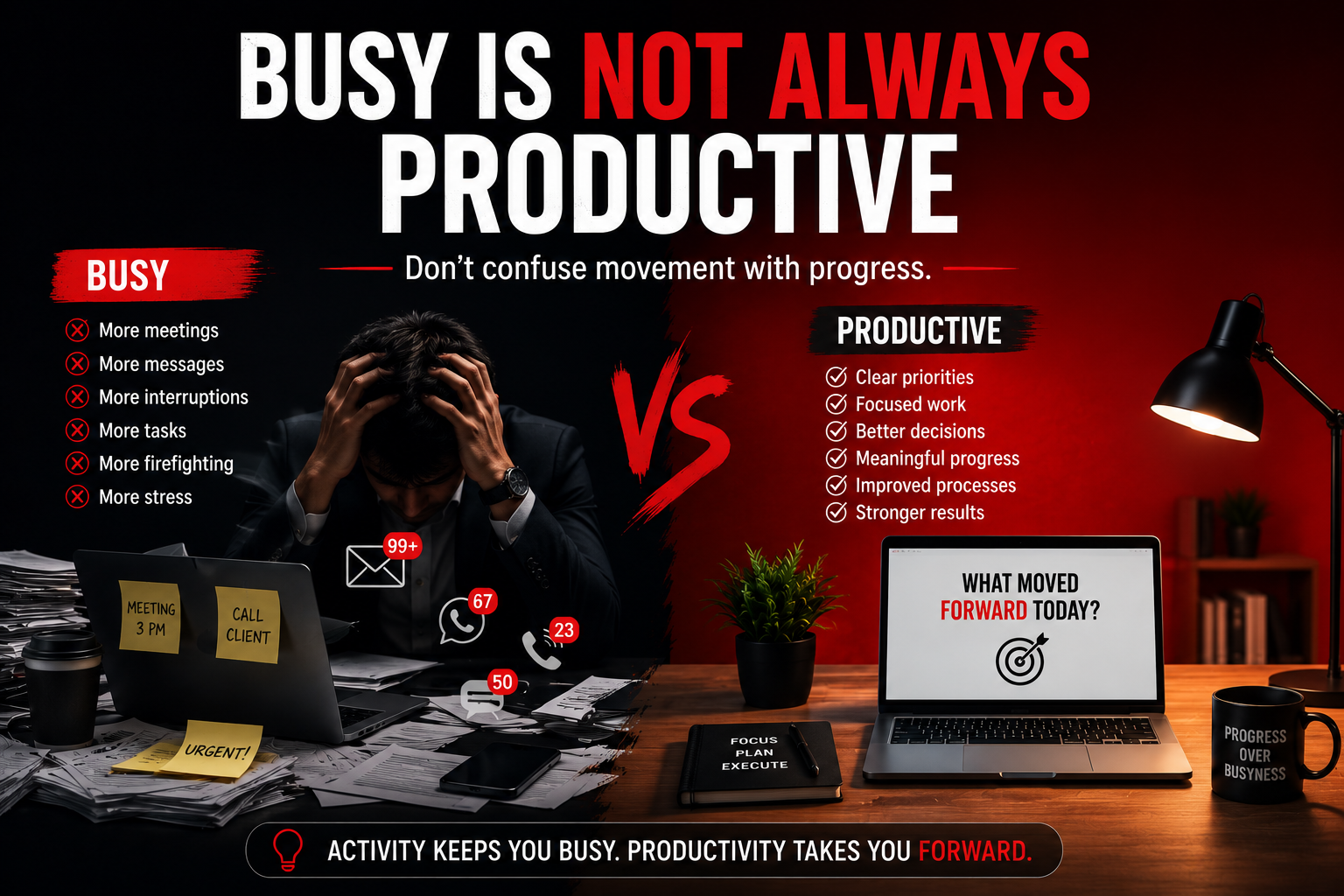
Busy vs Productive: What's the Difference?
| Busy | Productive |
|---|---|
| More activity | ✓ More meaningful progress |
| More tasks completed | ✓ Important tasks completed |
| Constant interruptions | ✓ Focused execution |
| Firefighting | ✓ Problem prevention |
| More meetings | ✓ Better decisions |
| More communication | ✓ Clear communication |
| Longer hours | ✓ Better use of time |
| More output | ✓ Valuable outcomes |
A productive business does not necessarily look busy from the outside. It may have fewer meetings, shorter emails and less firefighting. But it moves forward consistently.
Why Do Businesses Become Too Busy?
Busyness does not usually appear by accident. It is often the result of several underlying factors.
Poor Prioritization
When everything becomes urgent, nothing is truly important. Teams spend their time responding to the loudest voices rather than working on the most valuable activities.
Lack of Clear Responsibilities
When ownership is unclear, multiple people handle the same work, while some work has no clear owner at all. This creates duplication and gaps.
Too Many Meetings
Meetings become a substitute for decisions or execution. People attend because they are invited, not because they are needed.
Poor Processes
Employees spend their time figuring out how to complete routine tasks. Instead of working, they navigate confusion.
Repetitive Manual Work
People repeatedly enter, search, copy or verify the same information. This consumes time without adding value.
Constant Firefighting
Teams spend their time solving symptoms rather than root causes. The same problems return repeatedly.
Founder or Manager Dependency
Small decisions continuously move upward. Leaders become bottlenecks rather than enablers.
Poor Communication
Information is scattered across email, WhatsApp, calls and documents. People spend time searching for what they need.
Lack of Visibility
Managers don't know what is actually happening, so they spend time requesting updates instead of making decisions.
Task Switching
Employees constantly move between unrelated activities. This reduces focus and increases the time required to complete work.
The Difference Between Activity and Progress
This is one of the most important distinctions in business.
Activity is the work being done. Progress is the change that results from that work.
A business can have a lot of activity and very little progress. It can also have limited visible activity and significant progress.
Consider these examples:
- A sales team makes hundreds of calls but generates very few qualified opportunities. Activity is high. Progress is low.
- A manager attends multiple meetings but makes no meaningful decisions. Activity is visible. Progress is absent.
- An operations team processes hundreds of requests but spends significant time correcting avoidable errors. Activity is measurable. Progress is questionable.
Activity is measurable, but activity alone does not guarantee value.
The question leaders should ask is not:
“How much work did we do?”
But rather:
“What changed because we did the work?”
The Hidden Cost of Constant Busyness
Constant busyness is not harmless. It has real costs.
- Lost productivity: Time spent on low-value activity is time not spent on valuable activity.
- Delayed decisions: When everyone is too busy, important decisions wait.
- Employee fatigue: Sustained busyness leads to exhaustion and reduced performance.
- Burnout risk: Employees who feel constantly overwhelmed are more likely to disengage or leave.
- Higher operational costs: Inefficient processes require more people and more time.
- Customer dissatisfaction: When teams are too busy, customer service suffers.
- Missed opportunities: Focus on urgency crowds out exploration of new possibilities.
- Repeated mistakes: Busy teams rarely have time to learn from errors.
- Poor strategic thinking: Strategic work is postponed in favour of immediate demands.
- Founder exhaustion: Leaders who are involved in everything rarely have time to lead.
- Reduced innovation: Innovation requires space and reflection - both are scarce in a busy organisation.
Why Employees Can Be Busy Because the System Is Inefficient
This point matters.
An employee may work extremely hard and still be trapped inside an inefficient process.
If an employee has to manually search five different places for customer information, the problem is not the employee's speed. The process itself creates unnecessary work.
If a manager approves the same type of decision dozens of times, the problem is not the manager's workload. The process could be redesigned.
If a team spends hours coordinating through messages, the problem is not the team's effort. The communication structure may be the problem.
There is a difference between:
- Employee performance problems - where employees are not working effectively
- Process and system problems - where the work itself is poorly designed
Many businesses mistake the first for the second. Employees who appear busy may be working hard within a broken system.
The Founder Trap
Founders often become the center of every decision. In early-stage businesses, this makes sense.
The founder knows the customers, suppliers, employees, payments, projects, problems and priorities. They are the connective tissue of the organization.
But as the company grows, this becomes a bottleneck.
The founder becomes the approval point for everything. Nothing moves forward without their input. Every small decision waits for them.
This creates busyness for the founder and busyness for everyone else waiting for decisions.
The shift that needs to happen is from:
“I need to know everything.”
to:
“I need visibility into what matters.”
This transition is not easy. It requires trust, clear processes and the willingness to let go of control.
Meetings: Activity or Productivity?
Meetings are one of the most common sources of business busyness.
Many meetings are unnecessary. They happen because they have always happened, not because they are needed.
Unnecessary meetings tend to share common characteristics:
- No clear objective or agenda
- Information that could have been shared via a brief message
- No decision made or action taken
- Too many participants
- Repeated status updates that rarely change
- Meetings replacing accountability
Meetings can be valuable for complex decisions, strategic discussions, problem-solving and collaboration. The goal is not to eliminate meetings. The goal is to make them purposeful.
Communication Overload
Modern work involves constant communication: email, WhatsApp, Slack or similar tools, calls, notifications and group chats.
This constant availability can create the illusion of productivity while reducing focused work.
There is a difference between:
Being available
and
Being productive.
Responding to messages quickly feels productive. But it often interrupts more important work. Constant communication is activity. It is not always progress.
Multitasking and Task Switching
Constantly moving between tasks reduces effectiveness.
Examples:
- Answering messages while preparing reports
- Taking calls while handling customer requests
- Switching between sales, operations and finance
- Constant notification checking
Task switching has a cost. When you move from one activity to another, there is a transition cost - time and mental energy spent reorienting.
Focused work is more effective than fragmented work. This is not a productivity trick. It is a practical reality of how attention works.
Productivity Is Not the Same as Working Longer
Long working hours are not automatically a sign of a productive organisation.
Sometimes long hours are necessary during genuinely demanding periods. Product launches, major projects and seasonal peaks may require extended effort.
The problem is when long hours become a permanent substitute for better systems and priorities.
When employees work long hours because processes are inefficient, tasks are unclear or planning is poor, those hours are not a sign of commitment. They are a sign of a system that needs attention.
Efficiency vs Effectiveness vs Productivity
These terms are often used interchangeably, but they mean different things.
Efficiency
Doing something with fewer wasted resources.
Effectiveness
Doing the right thing and achieving the intended result.
Productivity
Producing meaningful output relative to the resources used.
The important insight is this:
A business can be efficient at doing the wrong thing.
You can process orders efficiently, but if you are processing the wrong orders or orders that should not exist, efficiency does not help.
Productivity requires both effectiveness and efficiency. You need to do the right things and do them well.
How to Identify Whether Your Business Is Too Busy
Here are practical signs to look for:
- Are employees constantly interrupted throughout the day?
- Do meetings consume large portions of the week?
- Does the founder or manager approve too many small decisions?
- Are the same problems repeatedly solved?
- Do employees spend time searching for information?
- Are tasks frequently forgotten or delayed?
- Do people work long hours just to keep up?
- Does management spend more time chasing updates than making decisions?
- Are important strategic projects continuously postponed?
- Do customers wait for responses because internal coordination is slow?
If several of these signs are present, busyness may be masking deeper operational problems.
Measuring Productivity Properly
Businesses should measure outcomes, not just activity.
Instead of number of calls, consider qualified opportunities generated.
Instead of number of meetings, consider decisions made or actions completed.
Instead of hours worked, consider meaningful work completed.
Instead of number of tasks, consider business impact.
The right metrics depend on the function and the business model. But the principle is consistent: measure what matters, not just what is easy to count.
How Businesses Can Reduce Unnecessary Busyness
Reducing busyness requires systemic change, not just individual effort.
Prioritization
Identify what actually matters. Not everything can be a priority. Leadership must make clear choices.
Clear Ownership
Every important task should have clear responsibility. When ownership is clear, accountability follows.
Better Processes
Remove unnecessary steps. Simplify where possible. Make routine work straightforward.
Documentation
Reduce dependence on memory. When information is documented, it can be shared, updated and improved.
Standardization
Create consistent ways of handling recurring work. This reduces decision fatigue and ensures quality.
Automation
Automate repetitive, predictable activities where appropriate. Automation should solve a real problem, not be implemented for its own sake.
Better Information Management
Make important information easier to access. When information is visible, decision-making becomes faster.
Decision Frameworks
Allow teams to make appropriate decisions without unnecessary escalation. Trust people to make decisions within defined boundaries.
Review and Improvement
Regularly question whether existing activities still create value. What was useful last year may no longer be necessary.
Technology and Productivity
Technology can reduce unnecessary work, but technology cannot automatically create productivity.
Businesses should first understand the problem, the process and the desired outcome. Then decide whether technology or automation is appropriate.
Technology can help with automated notifications, digital records, workflow management, reporting, customer information systems, task tracking and data dashboards.
But technology alone is not the solution. Technology applied to a poor process simply makes the poor process faster.
The Role of Leadership
Productivity is not simply an employee responsibility. Leadership influences priorities, culture, meetings, decision-making, processes, accountability, communication and resource allocation.
A CEO should ask:
"Are we asking our people to work harder, or are we making it easier for them to do valuable work?"
This is a different question from "How can we increase productivity?" It shifts the focus from individual effort to system design.
Creating a Culture of Meaningful Work
Organisations can shift from:
"Everyone is busy."
to:
"Everyone understands what matters."
This requires clear priorities, outcome-oriented thinking, ownership, trust, focus and continuous improvement.
It means measuring progress, not activity. It means having honest conversations about what is working and what is not. It means designing work so that employees can focus on the tasks that actually create value.
When Busyness Is Actually Necessary
There will be genuinely busy periods.
Product launches, major projects, seasonal demand, customer emergencies, business expansion and unexpected operational problems all require extra effort.
The goal is not to eliminate busyness. The goal is to prevent permanent operational chaos from being mistaken for productivity.
Busy periods are acceptable. Permanent busyness is a sign of something deeper.
A Simple Framework
Here is a framework to evaluate any activity:
This framework helps separate activity from progress.
Questions Business Leaders Should Ask
- What work creates the most value?
- What work consumes the most time?
- Are those two things the same?
- What activities are repeated unnecessarily?
- Which decisions are unnecessarily centralized?
- Where does information get lost?
- What problems keep coming back?
- What work could be eliminated?
- What could be simplified?
- What could be automated?
- What important work keeps getting postponed?
These questions are not about blaming employees. They are about understanding the business system.
Final CEO Perspective
A productive business isn't the one where everyone looks busy.
It is the one where people know what matters. Work has clear ownership. Processes reduce unnecessary effort. Decisions move forward. Problems are prevented. Time is spent on meaningful outcomes. The business continues progressing.
If you find yourself constantly busy but not sure what you are actually building, it may be time to look at the system - not the effort.
Because a busy business is not always a productive business.
But a productive business can often become a lot less busy.