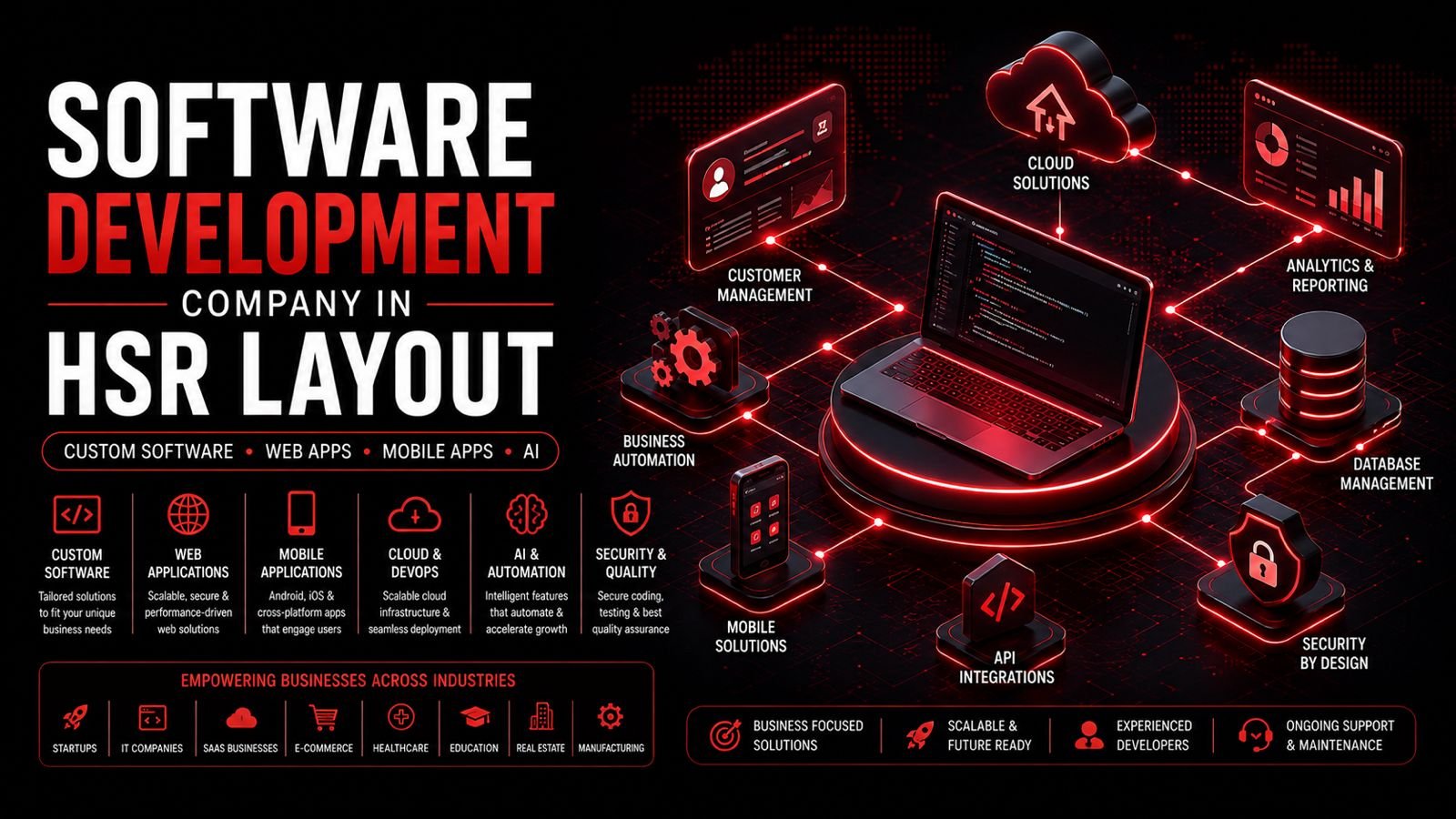
A Software Development Company in HSR Layout designs, builds, and maintains custom software solutions - including web applications, mobile apps, enterprise systems, and SaaS platforms - that help businesses automate workflows, integrate operations, and solve unique business problems. For startups, IT companies, and enterprises in HSR Layout and South Bengaluru, custom software provides flexibility, scalability, and competitive advantage that off-the-shelf products cannot deliver.
- Custom software is built specifically for your business processes - not the other way around
- HSR Layout businesses need custom solutions to address unique workflows, integrate systems, and scale operations
- Custom development includes web applications, mobile apps, ERP, CRM, SaaS platforms, and business automation
- Key benefits include perfect business fit, competitive advantage, scalability, and long-term cost efficiency
- Custom software replaces multiple disconnected tools, spreadsheets, and manual processes that limit growth
- AI-powered custom software offers automation, predictive analytics, and intelligent business insights
- 1. What Is Software Development?
- 2. Why HSR Layout Businesses Need Custom Software
- 3. Business Ecosystem in HSR Layout
- 4. Custom Software vs Ready-Made Software
- 5. Software Development Process
- 6. Types of Software Development
- 7. Software for Startups
- 8. Software for SMEs
- 9. Software for IT & SaaS Companies
- 10. Enterprise Software
- 11. Web App vs Mobile App vs Website
- 12. Technology Stack
- 13. AI in Software Development
- 14. Software Automation
- 15. Software Integrations
- 16. Software Security
- 17. Cloud Software Development
- 18. Software Performance
- 19. Cost & Timeline
- 20. Software Modernization
- 21. Software Maintenance
- 22. When to Build Custom Software
- 23. Benefits for HSR Layout Businesses
- 24. How to Choose a Development Company
- 25. Buyer Checklist
- 26. Project Roadmap
- 27. Common Development Mistakes
- 28. FAQs
- 29. Conclusion
- 30. Get Started
What Is Software Development?
Software Development is the process of designing, building, deploying, and maintaining software applications that solve specific business problems. For businesses in HSR Layout, custom software provides solutions that off-the-shelf products cannot deliver.
Key areas of software development:
- Custom Software: Built specifically for your business processes
- Web Applications: Browser-based business systems
- Mobile Applications: Android and iOS apps for mobile access
- Enterprise Applications: Large-scale business systems
- SaaS Platforms: Scalable subscription-based software
- API Development: Connecting business systems
- Cloud Applications: Scalable cloud-based solutions
- AI Applications: Intelligent automation and insights
Why HSR Layout Businesses Need Custom Software
Businesses in HSR Layout and South Bengaluru face unique challenges that make custom software essential:
- Manual Processes: Paper-based workflows slow down operations
- Disconnected Systems: Multiple tools that don't communicate with each other
- Spreadsheet Dependency: Critical business data in spreadsheets
- Duplicate Data Entry: Entering the same information multiple times
- Poor Reporting: Manual report compilation
- Difficult Approvals: Slow approval workflows
- Industry-Specific Requirements: Standard software doesn't fit
- Integration Limitations: Inability to connect systems
- Scalability Problems: Systems that can't handle growth
Business Ecosystem in HSR Layout
HSR Layout's Business Landscape
HSR Layout is a premier business and residential hub with businesses across:
- IT & Software: Global technology companies and software development firms
- SaaS Startups: Hundreds of innovative product companies and startups
- Digital Agencies: Digital marketing, design, and creative agencies
- Retail & Hospitality: Shopping centers, restaurants, and cafes
- Healthcare: Hospitals, clinics, and diagnostic centers
- Professional Services: Consulting firms, legal practices, and service providers
Businesses in HSR Layout need custom software to address unique requirements, integrate systems, and drive innovation.
IT & Startups in HSR Layout
HSR Layout and Koramangala host thousands of IT companies and startups that need custom software for product development, internal operations, and customer-facing solutions.
Manufacturing & Engineering Companies
Surrounding industrial areas host manufacturing and engineering companies that need custom ERP, production planning, inventory, and quality management software.
Custom Software vs Ready-Made Software
| Factor | Ready-Made Software | Custom Software |
|---|---|---|
| Business Fit | May require process changes | ✓ Perfect match |
| Customization | Limited to configuration | ✓ Full control |
| Scalability | Vendor-dependent | ✓ Designed for growth |
| Integrations | Limited | ✓ Seamless |
| User Experience | Generic | ✓ Tailored |
| Ownership | Vendor-owned | ✓ Full ownership |
| Upfront Cost | Lower | Higher |
| Long-term Flexibility | Limited | ✓ Highly flexible |
Software Development Process
Requirement Analysis
Business Process Mapping
Product & Technical Planning
UI/UX Design
Software Development
Integration
Testing
Deployment
Training
Maintenance
Types of Software Development
Business Software
Custom business applications
ERP Software
Integrated business management
CRM Software
Customer & sales management
HR & Payroll
Human resource management
Inventory Management
Stock & warehouse control
Finance Management
Accounting & financial control
Project Management
Task & project tracking
Construction Software
Project & site management
Real Estate Software
Property management
Manufacturing Software
Production planning & control
School & Education
Student & academic management
Healthcare Software
Patient & clinic management
E-commerce Platforms
Online selling & payments
SaaS Platforms
Scalable subscription software
Customer Portals
Customer self-service
Employee Portals
Employee self-service
Workflow Automation
Process automation
Web Applications
Browser-based business systems
Mobile Applications
Android & iOS apps
Software Development for Startups in HSR Layout
Startups in HSR Layout need custom software for:
- MVP Development: Build a Minimum Viable Product to validate the idea
- Product Validation: Test the product with real users
- Feature Prioritization: Focus on essential features first
- Scalable Architecture: Designed to handle growth
- SaaS Development: Build scalable subscription platforms
- Customer Portals: Self-service for customers
- Admin Panels: Backend management for the team
- API Integrations: Connect with third-party services
- Analytics: User behavior tracking and insights
- Cloud Deployment: Scalable cloud infrastructure
Custom Software Development for SMEs
SMEs need custom software for:
- Sales Automation: Automate sales processes
- Customer Management: Centralized customer information
- Finance: Invoicing, expense tracking, and reporting
- Inventory: Stock control and warehouse management
- HR: Employee management and payroll
- Projects: Project tracking and resource allocation
- Reporting: Business performance analytics
- Workflow Automation: Automated business processes
- Business Intelligence: Data-driven insights
Software Development for IT & SaaS Companies
IT and SaaS companies need custom software for:
- SaaS Products: Scalable subscription-based platforms
- Customer Portals: Customer self-service and account management
- Subscription Systems: Billing, invoicing, and subscription management
- API Platforms: API-first product development
- Admin Panels: Management dashboards for administrators
- Multi-tenant Applications: Scalable multi-user systems
- User Management: Authentication, authorization, and user profiles
- Billing Systems: Invoicing and payment processing
- Analytics: User behavior and business analytics
- Cloud Infrastructure: Scalable cloud deployment
Enterprise Software Development
Enterprise software development involves:
- Multiple Departments: Cross-departmental workflows
- Multiple Users: Large-scale user management
- Role-Based Access: Granular permission management
- Complex Workflows: Multi-step business processes
- Integrations: Connect with multiple enterprise systems
- Data Governance: Data quality and compliance
- Reporting: Enterprise-wide reporting and analytics
- Scalability: Systems that handle enterprise growth
- Security: Enterprise-grade security measures
- Audit Trails: Complete activity logging
Web Application vs Mobile Application vs Website
| Solution | Best For | Key Strength |
|---|---|---|
| Website | Public information & SEO | Reach & visibility |
| Web Application | Business workflows | Browser-based operations |
| Mobile Application | Mobile users | Device-based experience |
| Enterprise Software | Complex operations | Integrated workflows |
Technology Stack
Frontend
Backend
Databases
Mobile
Cloud
AI in Software Development
Practical AI Applications Available Today
- AI Assistants: Intelligent help and guidance for users
- AI Chatbots: 24/7 customer support and engagement
- AI Search: Intelligent search across business data
- Document Processing: Extract data from invoices, contracts, and forms
- Recommendation Engines: Product and content recommendations
- Predictive Analytics: Forecast business trends and outcomes
- AI Reporting: Generate reports from natural language queries
- Natural Language Interfaces: Conversational interactions
- Intelligent Workflow Automation: AI-driven process optimization
- AI Customer Support: Automated support and ticket routing
Software Automation
- Lead Assignment: Auto-assign leads to team members
- Approvals: Automated approval workflows
- Notifications: Automated alerts and reminders
- Invoicing: Automated invoice generation and sending
- Inventory Updates: Auto-update stock levels
- Employee Workflows: Automated task assignment
- Customer Onboarding: Automated onboarding workflows
- Reports: Auto-generated reports and dashboards
- Payment Reminders: Automated payment follow-ups
- Task Allocation: Auto-assign tasks based on triggers
- Data Synchronization: Sync data across systems
Software Integrations
- ERP: Sync data with enterprise systems
- CRM: Access customer data
- Accounting: Financial data sync
- HRMS: Employee and payroll data
- Inventory: Stock and product data
- Payment Gateways: Secure payment processing
- Websites: Lead capture and customer engagement
- Mobile Apps: Mobile access to systems
- Email: Communication integration
- WhatsApp: Customer communication
- APIs: Custom integrations with any system
- Analytics: Business performance tracking
Software Security
- Authentication: Strong user authentication
- Authorization: Granular permission management
- Role-Based Access: Access control by role
- Encryption: Data encrypted in transit and at rest
- API Security: Secure API communication
- Secure Coding: Security best practices in development
- Database Security: Secure data storage
- Audit Logs: Comprehensive activity logging
- Backups: Regular automated backups
- Monitoring: Continuous security monitoring
- Vulnerability Management: Regular security assessments
- Secure Deployment: Security in deployment
Cloud Software Development
- Scalability: Elastic scaling of resources
- Remote Access: Access from anywhere
- Availability: High availability infrastructure
- Infrastructure Management: Managed cloud infrastructure
- Backup: Automated backup and recovery
- Monitoring: Real-time performance monitoring
- Deployment: Automated deployment pipelines
- Cost Considerations: Pay-as-you-go pricing
Software Performance
- Application Speed: Fast loading and response times
- Database Optimization: Optimized queries and indexing
- API Performance: Fast API response times
- Caching: Efficient caching strategies
- Load Handling: Handle concurrent users and traffic
- Code Optimization: Efficient, clean code
- Cloud Infrastructure: Scalable cloud resources
- Monitoring: Real-time performance monitoring
- Scalability: Systems that grow with demand
Software Development Cost & Timeline
Factors Affecting Software Development Cost
- Number of Users: More users = more complexity
- Software Complexity: Simple, moderate, or complex
- Number of Modules: More modules = more development
- UI/UX Requirements: Design complexity
- Backend Architecture: Server, database, APIs
- Integrations: Third-party system connections
- Mobile Applications: Mobile app requirements
- AI Features: AI capabilities
- Security Requirements: Security measures
- Cloud Infrastructure: Hosting and infrastructure
- Testing: Quality assurance
- Maintenance: Ongoing support
Typical Development Timeline
Simple business software: 2-4 months. Custom business applications: 4-8 months. Enterprise platforms: 8-12+ months. Complex SaaS products: 12-18+ months. Factors affecting timeline include feature count, complexity, integrations, and testing requirements.
Software Modernization
Businesses should consider modernizing existing software when:
- Outdated Technology: Using unsupported or obsolete technology
- Poor Performance: Slow or unreliable software
- Security Concerns: Vulnerabilities in the current system
- Difficult Maintenance: Hard to maintain and update
- Lack of Integrations: Cannot connect with modern systems
- Poor User Experience: Outdated interface
- Scalability Limitations: Can't handle current business volume
- Legacy Infrastructure: Running on outdated infrastructure
Software Maintenance
- Bug Fixing: Address user-reported issues
- Security Updates: Regular security patches
- Server Maintenance: Server and infrastructure updates
- Database Maintenance: Database optimization and updates
- Performance Monitoring: Track and optimize performance
- Compatibility Updates: OS and browser compatibility
- Feature Improvements: Feature enhancements
- Backup Monitoring: Ensure backups are working
- Technical Support: User support and issue resolution
When Should a Business Build Custom Software?
A business in HSR Layout should consider custom software when:
- Existing Software Doesn't Fit: Off-the-shelf products don't match workflows
- Too Many Disconnected Tools: Multiple systems that don't integrate
- Manual Processes Are Increasing: Growing manual workload
- Business Requires Unique Workflows: Industry-specific processes
- Integration Requirements Are Complex: Need to connect multiple systems
- Reporting Needs Are Specific: Custom report requirements
- Business Is Scaling Rapidly: Growing operations need scalable systems
- Industry-Specific Functionality Required: Standard software doesn't meet needs
Benefits for HSR Layout Businesses
- Perfect Business Fit: Software that matches your workflows exactly
- Competitive Advantage: Unique features that competitors cannot replicate
- Full Ownership: You own the code and intellectual property
- Scalability: Built to grow exactly as your business grows
- Integration: Seamlessly connects with your existing systems
- Cost Efficiency: No licensing restrictions or vendor lock-in
- Security: Full control over security architecture
- Flexibility: Adapt and evolve as your business changes
- Long-term Value: Strategic investment in your business growth
How to Choose a Software Development Company
- Technical Expertise: Technology stack and domain experience
- Portfolio: Review past projects and industry experience
- Industry Experience: Experience in your industry
- Requirement Analysis: Strong requirement gathering process
- Technology Stack: Modern, scalable technology
- UI/UX Capabilities: User-centered design expertise
- Architecture: Strong software architecture expertise
- API Expertise: Third-party integration experience
- Cloud Expertise: Cloud deployment and management
- Security Practices: Security standards and data protection
- Testing Process: Quality assurance practices
- Scalability: Ability to scale development resources
- Documentation: Project documentation and handover
- Source-code Ownership: Clear ownership terms
- Data Migration: Data migration experience
- Maintenance: Ongoing support capabilities
- Pricing Transparency: Clear pricing and payment models
- Project Management: Clear communication and reporting
- Long-term Partnership: Commitment to long-term relationship
50-Point Software Development Checklist
Project Roadmap
- Discovery & Requirements: Understand your business, audience, and goals
- Architecture & Design: Create system architecture and UI/UX designs
- Development: Build the software with agile methodology
- Integration: Integrate with ERP, CRM, payment gateways, and cloud services
- Testing & QA: Thorough testing across platforms
- Deployment: Deploy to production environment
- Training: Train your team on the new system
- Launch: Launch the software
- Maintenance: Ongoing support, updates, and optimization
Common Software Development Mistakes
- Starting Without Clear Requirements: Vague requirements lead to problems
- Choosing Technology Only Based on Popularity: Not considering business needs
- Overbuilding the First Version: Building too many features initially
- Poor Database Architecture: Inefficient database design
- Ignoring Security: Not prioritizing security
- Weak API Architecture: Inefficient API design
- Poor UI/UX: Ignoring user experience
- Insufficient Testing: Inadequate testing across platforms
- No Scalability Planning: Not planning for growth
- No Documentation: Insufficient documentation
- Ignoring Maintenance: Neglecting post-launch support
- Choosing Solely on Lowest Price: Quality suffers
Frequently Asked Questions
Explore More Solutions
Conclusion: Build the Right Software for Your Business
In HSR Layout's technology-driven business environment, custom software is a strategic differentiator that enables businesses to operate efficiently, innovate faster, and scale with confidence. Off-the-shelf software, spreadsheets, and disconnected tools simply cannot provide the flexibility, integration, and competitive advantage that custom solutions deliver.
A trusted Software Development Company helps you:
- Build solutions tailored to your unique business processes
- Integrate operations across departments with custom ERP and CRM
- Automate manual work and improve business efficiency
- Leverage AI for smarter decisions and business insights
- Scale your technology as your business grows
- Gain a sustainable competitive advantage
Whether you are an IT company in HSR Layout, a startup in Koramangala, a manufacturer in Electronic City, or any business across South Bengaluru, the right software development partner is a strategic investment in your business growth and digital transformation.
Have a Business Process That Existing Software Can't Handle?
If your business in HSR Layout or South Bengaluru is looking to build secure, scalable, and future-ready custom software tailored to your unique business processes, discover how a professionally developed software solution can automate operations, improve efficiency, and support long-term growth. Request a free consultation to discuss the right custom software solution for your organization.