- Businesses can run without systems for a surprisingly long time - until complexity outgrows informal methods
- Growth doesn't create the need for systems; complexity does
- Systems are not about controlling people - they're about making important things predictable
- Buying software is not the same as building a system; processes must come before technology
- A good system frees people from unnecessary chaos so they can focus on what matters
A business can run without systems for a surprisingly long time. Until one day, it suddenly can't.
That's the thought I keep coming back to whenever I see a growing company struggling with things that used to be simple. It's not that the people changed. It's not that the business became worse at what it does. It's that complexity crept up, and the informal methods that worked before simply stopped working.
The bigger a business becomes, the less it can depend on memory, individual heroics and informal communication.
I've seen this pattern repeat across industries, company sizes and business models. A business that once operated smoothly on personal relationships and founder intuition eventually reaches a point where those same methods become bottlenecks. The transition is rarely dramatic. It happens gradually, over months and years, until one day someone realises that the business has become too large for the informal systems that built it.
This article isn't about software. It's not about automation or digital transformation or any of the buzzwords that get thrown around in business conversations. It's about something more fundamental: the way work actually gets done in a growing organisation, and why that way eventually has to change.
Why Informal Methods Work in the Beginning
In the early stages of a business, systems don't seem necessary. And in many cases, they probably aren't.
When everyone knows everyone, communication is fast, decisions are simple, customers are few and transactions are manageable. The owner knows most of the details personally. Problems can be solved directly.
This isn't necessarily bad management. It's often simply appropriate for the company's size.
A small business without complex systems isn't automatically badly managed. It's just operating at a scale where personal knowledge and direct communication can still carry the weight.
Consider a business with five employees, ten customers, a handful of suppliers and one decision-maker. The founder can personally know what's happening everywhere. They know which orders are pending, which customers need follow-up and which supplier is about to be late. There's no need for formal systems because the information fits inside one person's head.
But that weight increases as the business grows. And the methods that worked when the business was small become less effective as the business gets larger.
The Moment Complexity Starts
At first, the owner personally knows every customer and every order. Later, there are 50 customers, each with their own requirements and timelines.
At first, the owner remembers which supplier is reliable and which one is unpredictable. Later, there are 20 suppliers, each with different terms and lead times.
At first, the owner tracks every follow-up that needs to happen. Later, there are hundreds of follow-ups across multiple projects and teams.
The problem isn't that people became less capable. The problem is that the complexity has outgrown the method of managing it.
This is one of the most important shifts in any growing business. The question stops being, "What needs to be done?" and starts being, "How will we know it's being done?"
I've observed that businesses often underestimate how much complexity accumulates. A single new customer doesn't add much complexity. A new employee doesn't add much complexity. A new supplier doesn't add much complexity. But when these additions compound over months and years, the business becomes a system of interconnected dependencies that no single person can fully manage.
The first sign that a business needs a system is often not growth. It is repeated confusion.
When people start asking the same questions repeatedly, when tasks get forgotten, when customers receive inconsistent information, when decisions take longer than they should - these are signals that the informal methods are reaching their limit.
The Hidden Cost of Running Without Systems
When a business runs without systems, the consequences often don't appear as obvious failures. They appear as slower operations, inconsistent experiences and an increasing burden on the people who carry the information.
There's a dependency on individuals. If only one person knows how something works, the business becomes dependent on that person.
Information gets lost inside WhatsApp chats, emails, personal notebooks, spreadsheets and people's memory.
Decisions become slower because people spend time asking, "What happened?" instead of, "What should we do next?"
Errors increase because manual tracking becomes more vulnerable to mistakes as volume grows.
And founders become bottlenecks. When the founder has to approve every decision and remember every detail, the business stops growing in capacity even as it grows in size.
These costs don't appear on a balance sheet. They show up in the way work feels - the constant firefighting, the late nights, the sense that the business is always running on the edge of chaos. Many entrepreneurs accept this as normal, believing that running a business is simply supposed to be this difficult.
But the difficulty isn't inherent to the business. It's often a symptom of having outgrown the informal methods that used to work.
If the founder has to remember everything, the company hasn't yet converted knowledge into infrastructure.
Systems Are Not About Controlling People
There's a misconception that systems are about rules and bureaucracy. Some employees hear "systems" and think, "more control." Some business owners hear "systems" and think, "more paperwork."
But a good system shouldn't make work more difficult. It should actually reduce unnecessary dependency and confusion.
A good system answers questions like:
- Who is responsible?
- What needs to happen?
- When should it happen?
- What happens next?
- Who approves it?
- Where is the information stored?
- How do we know whether it's completed?
The goal isn't to control every action. The goal is to make the important things predictable.
I've worked with businesses where the lack of systems created friction between departments. Sales didn't know what production was working on. Production didn't know when materials would arrive. Finance didn't know what had been delivered. Everyone was doing their best, but the information wasn't flowing. The problem wasn't the people. The problem was that there was no system for information to travel through.
A good system helps people do their work better. It reduces the friction of coordination. It makes it easier to find information. It provides clarity about who is responsible for what.
Processes Before Technology
This is a point I think about often.
Buying software is not the same as building a system.
A company can purchase expensive software and still have poor processes. I've seen businesses invest in automation and dashboards only to discover that people are still doing things almost exactly the way they did before. The screens look better. The reports look more professional. The process is still broken.
If nobody knows who approves purchases, who follows up with customers, who updates inventory, who handles overdue payments, or who owns a particular task, software alone won't solve the underlying problem.
Technology can automate a process. But it cannot automatically determine whether the process itself makes sense.
That's why I believe the best technology decisions often begin with a whiteboard, not a software demonstration.
Before selecting a platform, I think there is value in doing something surprisingly simple. Take a process and draw it. Who starts it? Who touches it? Who approves it? Where does the information come from? Where does it go? Where does it wait? Where is it entered again? Where do mistakes happen? And perhaps the most important question: which step exists only because nobody has questioned it?
These conversations can reveal more than a technology demonstration. Because once the process is understood, technology selection becomes much easier. You are no longer buying features. You are solving defined operational problems.
A business system does not necessarily mean software. It can be processes, responsibilities, documentation, communication methods and decision-making structures.
When Should a Business Start Building Systems?
There's no revenue number that tells you it's time. The need usually appears when complexity begins creating friction.
Signs include:
- The founder is involved in every small decision.
- Employees repeatedly ask the same questions.
- Tasks are forgotten.
- Customers receive inconsistent updates.
- Information exists in multiple places.
- Reporting takes too long.
- Employees use different methods for the same task.
- New employees struggle to understand how work is done.
- Management doesn't have a clear picture of operations.
- The business becomes difficult to manage when one key person is absent.
These are signals of growing complexity. And they're often early indicators that the business needs more structure.
The challenge for many business owners is that these signs appear gradually. A few missed deadlines here, a few inconsistent customer experiences there. It's rarely a single dramatic failure that forces the issue. It's a slow erosion of operational clarity that eventually becomes hard to ignore.
Systems Should Grow With the Business
It's important not to build complexity before you need it. But it's equally important not to wait until complexity becomes chaos.
In the early stages, simple checklists, documentation, shared records and clear responsibilities may be enough. As the business grows, standard processes, approval flows, structured reporting and defined ownership become more important. At a larger stage, integrated systems, automation, analytics, controls and better data visibility may become necessary.
The principle I keep coming back to is this: Don't build complexity before you need it. But don't wait until complexity becomes chaos.
I've seen businesses that tried to implement enterprise-level systems at a stage when simpler methods would have worked. The systems became burdensome. They created more work than they solved. And they led to resistance from employees who saw them as unnecessary bureaucracy.
On the other hand, I've seen businesses that waited too long. By the time they started building systems, they were already struggling to manage the complexity. The transition was painful because they had to change deeply ingrained habits while also managing a growing business.
The right approach is somewhere in between. Build enough system to support the business at its current size, but ensure the system can scale as the business grows.
The Founder Transition
I believe one of the biggest transitions in entrepreneurship is when the founder moves from being the system to designing the system.
In the beginning, the founder is the system. They remember customers, employees, suppliers, payments, orders, problems, commitments. Everything runs through them.
But eventually, the business must move toward the system supporting the people. That's a significant shift.
A founder should gradually move from remembering everything to designing how things are remembered. From solving every problem to building a process that prevents recurring problems. From approving everything to defining what actually requires approval.
Growth doesn't create the need for systems. Complexity does.
This transition requires a different kind of leadership. Instead of being the person with all the answers, the founder becomes the person who designs the way the organisation finds answers. Instead of being the central point of coordination, the founder creates the coordination structures that allow the business to operate without them.
This is not an easy transition. For many founders, letting go of direct control feels uncomfortable. It requires trust in the system and in the people who work within it. But it's also the transition that allows the business to scale beyond the founder's personal capacity.
Systems Protect the Business From People Leaving
I want to be careful with this point. Good systems should not exist to replace people. People bring judgement, relationships, creativity and experience that no system can fully replicate.
But good systems can ensure that important organisational knowledge doesn't disappear when a person leaves.
Systems preserve process knowledge, records, history, responsibilities, decisions and documentation. They provide continuity. They make it possible for the business to continue functioning even when the person who built a process is no longer present.
A process becomes valuable when it continues to work even when the person who created it is not present.
In many businesses, key knowledge lives exclusively in the heads of a few people. When those people leave, the knowledge leaves with them. New employees have to relearn everything. Mistakes are repeated. Customers feel the inconsistency. This is one of the most expensive hidden costs of running without systems.
Good systems don't eliminate the need for knowledgeable people. But they do ensure that the institutional knowledge of how things work is captured and accessible.
Systems Also Create Freedom
Here's something I don't think people talk about enough.
Many people think systems make businesses rigid. But good systems can actually create freedom.
When routine work becomes predictable, managers spend less time chasing updates. Employees spend less time asking basic questions. Founders spend less time firefighting. Teams can make decisions faster. Businesses can scale more confidently.
The purpose of a good system is not to make people work like machines. It is to free people from unnecessary chaos.
When people aren't constantly putting out fires, they can focus on the work that actually matters.
I've experienced this firsthand. In businesses with good systems, people spend their time on high-value work - solving problems, serving customers, innovating. In businesses without systems, people spend their time hunting for information, clarifying responsibilities and recovering from mistakes.
The difference in productivity, morale and outcome is significant.
Practical Questions Every Business Should Ask
Instead of starting with a software purchase, I think it's more useful to start with honest questions:
- What information currently exists only in someone's memory?
- What happens when a key employee is absent?
- Which decisions always come back to the founder?
- Where do tasks get lost?
- Which process depends too heavily on one person?
- How many places contain customer information?
- Which reports take too long to prepare?
- Where do the same mistakes keep happening?
- What part of the business becomes difficult when volume increases?
These questions don't require expensive software. They require clarity. And clarity is often the most valuable investment a business can make.
I've found that these questions often lead to surprisingly simple solutions. Sometimes a single shared document solves the problem. Sometimes a weekly meeting clarifies responsibilities. Sometimes a simple checklist prevents forgotten tasks. The solution doesn't always have to be complex.
Balanced Perspective
I should also acknowledge that systems aren't perfect. Over-systemising a business can create its own problems: too many approvals, excessive bureaucracy, unnecessary documentation, slow decision-making, processes that become more important than outcomes, and employees following procedures without thinking.
The goal isn't to eliminate all judgement. It's to support judgement.
A system should support judgement, not eliminate judgement.
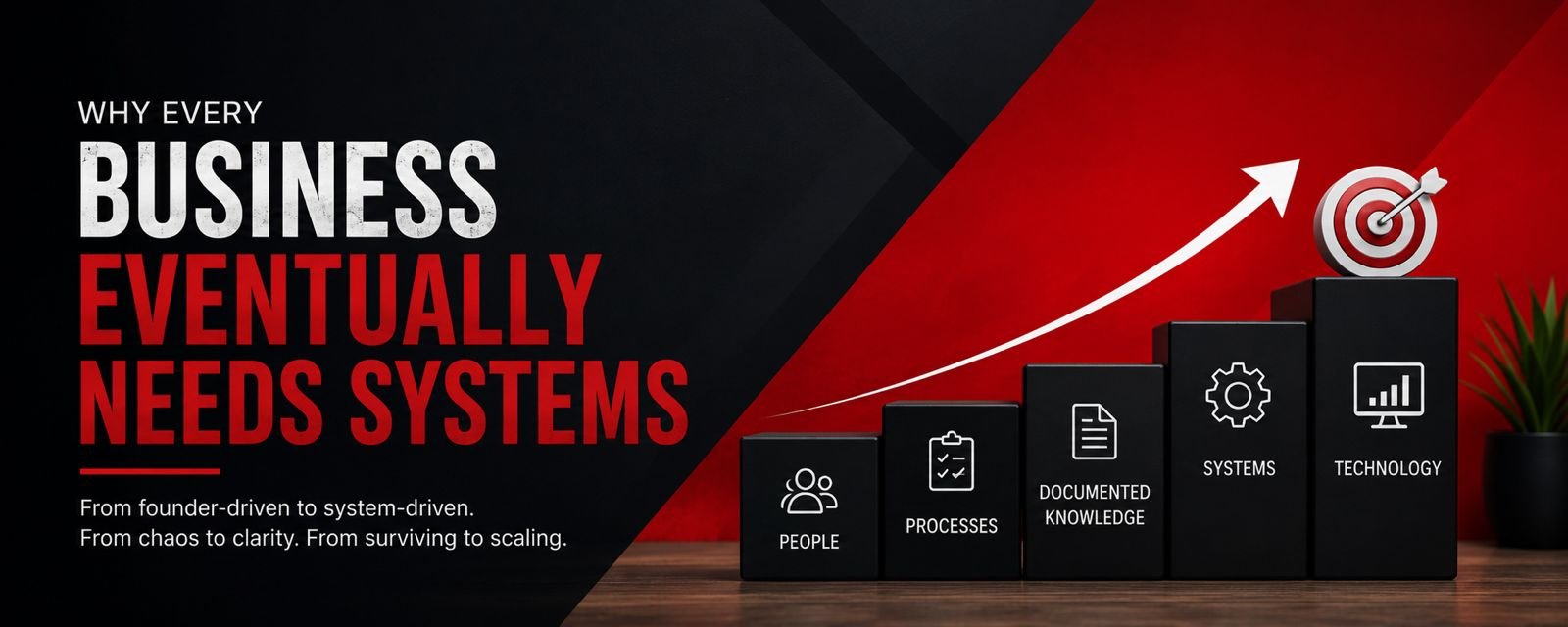
The best businesses combine people, process, systems, judgement and technology. They don't rely entirely on one.
I've seen businesses that swung too far in the direction of systems. They became rigid and bureaucratic. Decision-making slowed to a crawl. Employees felt disempowered. The systems that were supposed to help became obstacles.
The balance is important. Systems should serve the business, not the other way around. When a system stops serving the business, it's time to revisit it.
The Deeper CEO Perspective
I've come to believe that one of the biggest mistakes businesses make is treating technology as the starting point. It isn't. The starting point is understanding the business: understanding the workflow, understanding the people, understanding where decisions happen, understanding where time is lost, understanding what information matters. Then using technology to make that system better.
Not simply more digital. Not simply more automated. Better.
Because a bad process with no technology is frustrating. A bad process with technology is often just a more efficient way of producing frustration.
The first sign that a business needs a system is often not growth. It is repeated confusion.
I've also observed that businesses often underestimate the value of clarity. A clear process, even if it's simple, is more valuable than a sophisticated system that nobody understands. Clarity reduces friction, reduces errors and reduces the cognitive load on employees.
When I think about the most effective businesses I've worked with, they share a common characteristic: they have clear systems for the important things, and they trust their people to exercise judgement on the rest. They don't try to systemise everything. But they ensure that the critical functions - customer information, financial controls, production planning, communication - have clear, reliable systems behind them.
The Cost of Not Having Systems
There's another perspective worth considering. The cost of not having systems is often invisible. It doesn't appear as a single expense. It appears as slower growth, lower margins, higher employee turnover and missed opportunities.
When a business lacks systems, it can't scale efficiently. Every new customer, every new employee, every new product adds disproportionately to the complexity of the business. The founder's time becomes increasingly stretched. Decisions take longer. Quality becomes inconsistent. Customer experiences vary.
These costs compound over time. A business that could have grown steadily becomes stuck, unable to handle the complexity it has created. The founder works harder and harder just to keep things running, but the business doesn't grow.
This is one of the reasons I'm interested in systems. They're not about bureaucracy. They're about removing the friction that prevents businesses from growing.
What a Good System Looks Like
I think it's worth describing what a good system actually looks like in practice.
A good system is clear. Anyone who needs to use it can understand how it works.
A good system is consistent. It produces reliable results every time it's used.
A good system is efficient. It doesn't require unnecessary steps or effort.
A good system is flexible. It can adapt to changing circumstances without breaking.
A good system is transparent. It makes information available to those who need it.
A good system is designed for people, not for perfection.
These characteristics apply to everything from customer management to financial controls to production planning. The specific form of the system varies, but the underlying principles are the same.
Conclusion
Businesses eventually need systems because people cannot indefinitely carry organisational complexity in their heads.
I'm not saying every business should become bureaucratic. I'm saying that every business that wants to grow beyond the limits of individual memory and informal coordination needs to think about how it structures its work.
A business becomes scalable when its knowledge stops living only inside people's heads and starts living inside the way the business operates.
That's the transition I find most interesting. And it's one that every founder, leader and entrepreneur eventually has to navigate.
The businesses that navigate it well create the foundation for sustained growth. The businesses that don't often find themselves trapped in a cycle of increasing complexity and decreasing control.
Ultimately, systems aren't about replacing people with rules. They're about creating the conditions for people to do their best work. They're about removing the friction that prevents businesses from growing. And they're about ensuring that the knowledge and capability of the business outlasts any single individual.
If the founder has to remember everything, the company hasn't yet converted knowledge into infrastructure.
That's the thought I'll leave you with. And it's the one I keep coming back to every time I see a business that's struggling to manage its own growth.
Explore More Insights
A business becomes scalable when its knowledge stops living only inside people's heads.
If you're thinking about how to structure your business better, start with honest questions - not software purchases.